
Ever wondered why the same maths expression can produce different answers when solved in different ways?
The secret is not faster calculation it is the correct order of operations.
BODMAS gives you a simple sequence to follow, so every part of a mathematical expression is solved in the right order.
Once you understand what each letter means, even complicated-looking calculations become much easier.
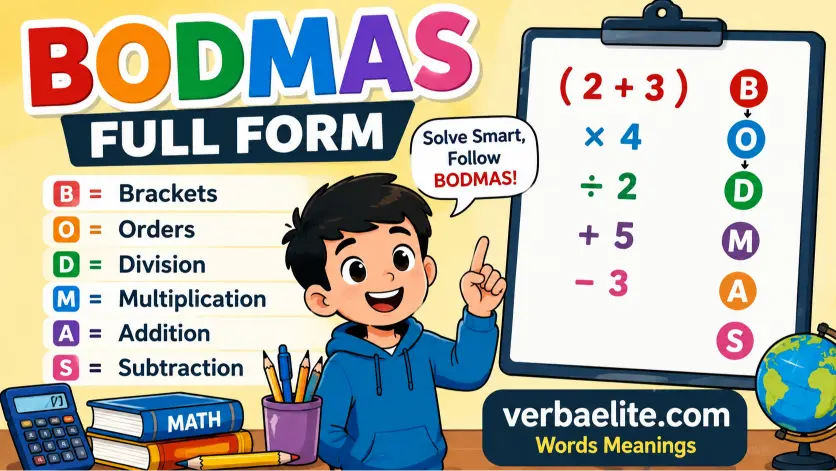
BODMAS is a mnemonic for Brackets, Orders, Division, Multiplication, Addition, and Subtraction. It describes the order in which mathematical operations are generally evaluated in an expression, with division and multiplication handled from left to right and addition and subtraction handled from left to right.
BODMAS stands for Brackets, Orders, Division, Multiplication, Addition, and Subtraction. It is the order of operations used to solve mathematical expressions correctly and consistently.
BODMAS Full Form
BODMAS stands for Brackets, Orders, Division, Multiplication, Addition, and Subtraction.
It is a mathematical rule used to determine the correct order in which operations should be performed in an expression containing multiple calculations.
| Letter | Full Form | What to Do |
|---|---|---|
| B | Brackets | Solve expressions inside brackets first |
| O | Orders | Solve powers, roots, and related orders |
| D | Division | Divide from left to right |
| M | Multiplication | Multiply from left to right |
| A | Addition | Add from left to right |
| S | Subtraction | Subtract from left to right |
A small but important point is that the O in BODMAS is commonly explained as Orders, referring to powers, indices, roots, and similar operations. Some educational sources use slightly different wording, such as “order” or “orders of operation.”
What Is BODMAS?
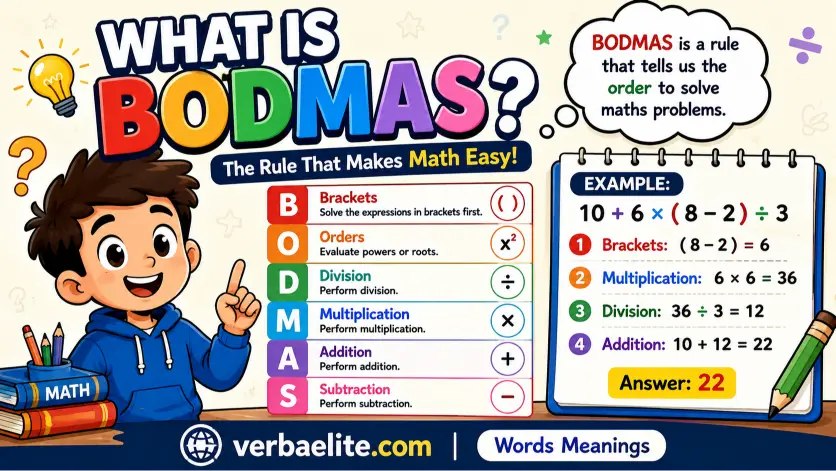
BODMAS is a mnemonic that helps students remember the standard sequence for evaluating mathematical expressions. When an expression contains several operations, you should not simply calculate everything from left to right.
Instead, follow the order represented by B-O-D-M-A-S.
For example:
8 + 4 × 2
If you add first:
8 + 4 = 12
12 × 2 = 24
That gives the wrong result because multiplication has priority over addition.
Using BODMAS:
4 × 2 = 8
8 + 8 = 16
Therefore:
8 + 4 × 2 = 16
The purpose of BODMAS is to remove this kind of ambiguity and provide a consistent method for evaluating expressions.
How Does the BODMAS Rule Work?
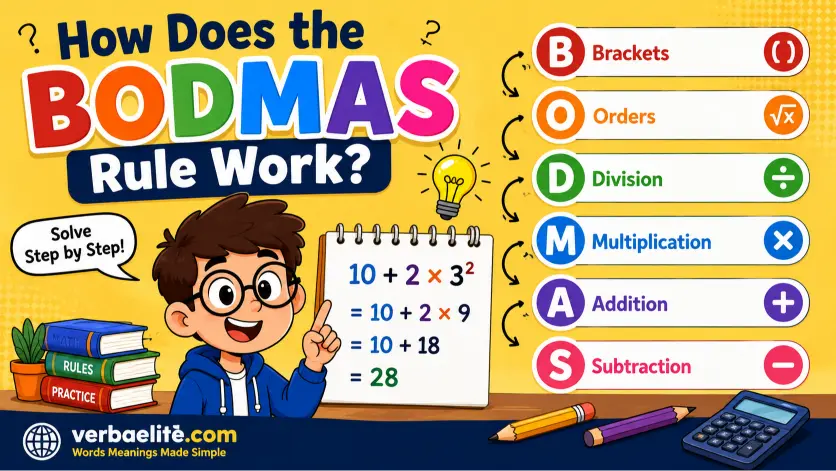
The easiest way to understand BODMAS is to treat it as a sequence of priorities.
1. B — Brackets
Start by solving whatever is inside brackets.
Example:
6 × (4 + 2)
First solve the brackets:
4 + 2 = 6
Then:
6 × 6 = 36
If there are several nested brackets, begin with the innermost expression and work outward.
2. O — Orders
After brackets, solve orders such as powers, exponents, indices, and roots where applicable.
Example:
3² + 4
First solve the order:
3² = 9
Then:
9 + 4 = 13
Orders are also sometimes described using terms such as powers, indices, or exponents depending on the educational system.
3. D — Division
Next, perform division.
Example:
24 ÷ 6 + 3
First:
24 ÷ 6 = 4
Then:
4 + 3 = 7
4. M — Multiplication
Multiplication is handled at the same level of priority as division.
Example:
5 + 3 × 4
First:
3 × 4 = 12
Then:
5 + 12 = 17
5. A — Addition
Once brackets, orders, division, and multiplication have been handled, perform addition.
Example:
7 + 5 − 2
Addition comes before the remaining subtraction:
7 + 5 = 12
12 − 2 = 10
6. S — Subtraction
Subtraction is performed after the higher-priority operations and is handled from left to right when it shares the same level as addition.
Example:
15 − 4 + 3
Work from left to right:
15 − 4 = 11
11 + 3 = 14
Important Rule: Division and Multiplication Have Equal Priority
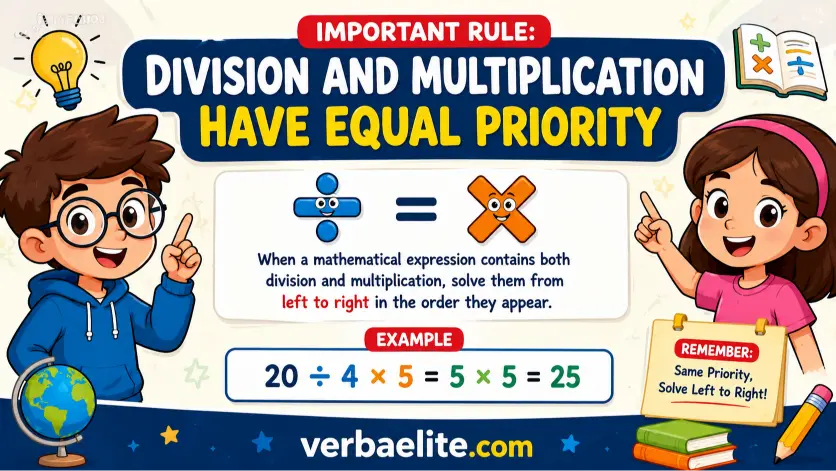
One of the most common BODMAS misunderstandings is believing that division must always happen before multiplication.
That is not correct.
Division and multiplication have equal precedence. When both occur at the same level, evaluate them from left to right. The same principle applies to addition and subtraction.
For example:
24 ÷ 4 × 3
Start from the left:
24 ÷ 4 = 6
Then:
6 × 3 = 18
You should not automatically multiply 4 × 3 first simply because M appears after D in the word BODMAS.
BODMAS Examples
Example 1: Simple Expression
10 + 5 × 2
Multiplication first:
5 × 2 = 10
Then addition:
10 + 10 = 20
Answer: 20
Example 2: Brackets
(10 + 5) × 2
Brackets first:
10 + 5 = 15
Then multiplication:
15 × 2 = 30
Answer: 30
Notice how adding brackets changes the result.
Example 3: Division and Addition
30 ÷ 5 + 7
Division first:
30 ÷ 5 = 6
Then:
6 + 7 = 13
Answer: 13
Example 4: Orders
2³ + 5
First solve the power:
2³ = 8
Then:
8 + 5 = 13
Answer: 13
Example 5: Multiple Operations
18 + 6 ÷ 3 × 2
Division and multiplication have equal priority, so work from left to right:
6 ÷ 3 = 2
2 × 2 = 4
Then:
18 + 4 = 22
Answer: 22
Example 6: Brackets and Orders
2 × (3² + 1)
First solve the order:
3² = 9
Then the brackets:
9 + 1 = 10
Finally:
2 × 10 = 20
Answer: 20
Example 7: A Longer Expression
50 − (8 + 2) × 3
Brackets:
8 + 2 = 10
Multiplication:
10 × 3 = 30
Subtraction:
50 − 30 = 20
Answer: 20
Example 8: Nested Calculation
100 ÷ (5 × 2) + 6
Brackets first:
5 × 2 = 10
Division:
100 ÷ 10 = 10
Addition:
10 + 6 = 16
Answer: 16
BODMAS Rule in a Simple Table
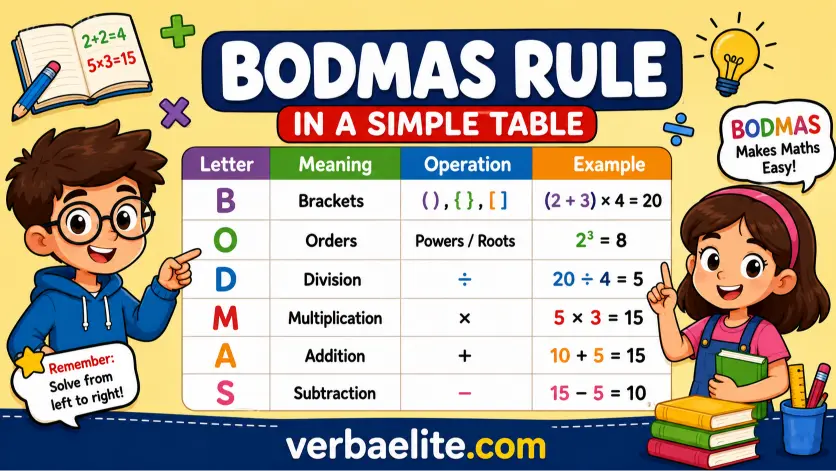
| Step | Operation | Example | Result |
| 1 | Brackets | (5 + 3) | 8 |
| 2 | Orders | 2³ | 8 |
| 3 | Division | 20 ÷ 5 | 4 |
| 4 | Multiplication | 4 × 6 | 24 |
| 5 | Addition | 7 + 8 | 15 |
| 6 | Subtraction | 15 − 6 | 9 |
This sequence is a memory aid, but remember that division and multiplication share precedence, as do addition and subtraction. They should be evaluated from left to right within their respective levels.
Why Is BODMAS Important?
BODMAS is important because mathematical expressions can contain several operations at once. Without an agreed order, different people might calculate the same expression differently.
For example:
5 + 2 × 3
The BODMAS method gives:
2 × 3 = 6
5 + 6 = 11
This consistency is especially useful when solving algebraic expressions, equations, school mathematics, examination questions, and more advanced mathematical problems.
The rule is taught across different levels of education and provides students with a systematic approach to evaluating expressions.
BODMAS vs PEMDAS
You may have heard another term: PEMDAS.
PEMDAS is another mnemonic for the order of operations. It commonly stands for:
- P — Parentheses
- E — Exponents
- M — Multiplication
- D — Division
- A — Addition
- S — Subtraction
The main difference is the terminology used for brackets/parentheses and orders/exponents, and the position of multiplication and division in the mnemonic.
The important mathematical principle is that multiplication and division are performed at the same precedence level from left to right, rather than treating one as universally higher than the other.
BODMAS vs BIDMAS
Another variation you may encounter is BIDMAS.
BIDMAS generally means:
- B — Brackets
- I — Indices
- D — Division
- M — Multiplication
- A — Addition
- S — Subtraction
Here, Indices refers to powers or exponents.
So, BODMAS and BIDMAS are closely related ways of remembering the same basic order-of-operations concept.
Common BODMAS Mistakes
1. Solving strictly from left to right
This is the most common mistake.
For:
4 + 3 × 2
Do not calculate 4 + 3 first.
Correct:
3 × 2 = 6
4 + 6 = 10
2. Treating multiplication as more important than division
Multiplication and division have equal precedence.
For:
40 ÷ 5 × 2
Calculate from left to right:
40 ÷ 5 = 8
8 × 2 = 16
3. Ignoring brackets
Consider:
5 × (2 + 4)
The bracket must be solved first:
2 + 4 = 6
Then:
5 × 6 = 30
4. Forgetting powers or roots
In expressions containing orders, calculate them at the appropriate stage before ordinary multiplication, division, addition, or subtraction.
Example:
4 + 2² × 3
First:
2² = 4
Then:
4 × 3 = 12
Finally:
4 + 12 = 16
5. Using the acronym mechanically
BODMAS is a memory tool, not a command to always perform every letter separately.
If an expression contains no brackets or powers, you simply move to the operations that are actually present.
How to Use BODMAS Naturally in Problem Solving
A good method is to avoid trying to calculate everything mentally at once.
Instead:
- Look at the entire expression.
- Identify brackets.
- Find powers, roots, or other orders.
- Perform division and multiplication from left to right.
- Perform addition and subtraction from left to right.
- Check your answer against the original expression.
Writing one step at a time makes mistakes easier to spot.
BODMAS Quick Trick for Students
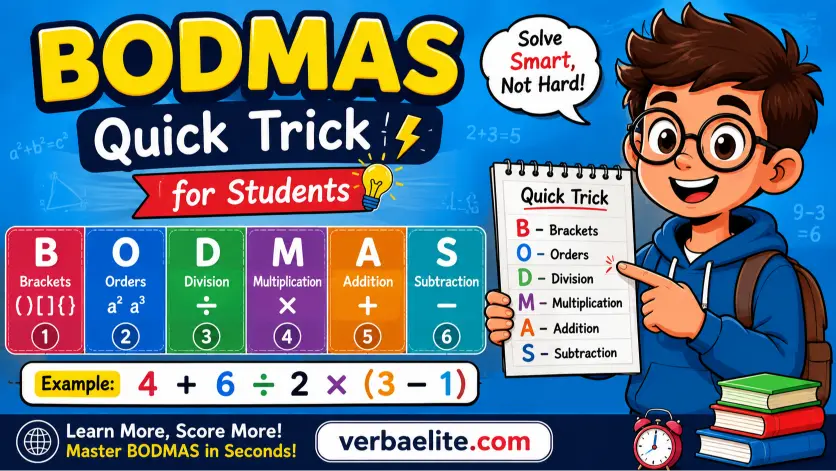
Remember:
B → Brackets
O → Orders
D → Division
M → Multiplication
A → Addition
S → Subtraction
A useful way to think about the rule is:
Group first, powers next, multiply or divide, then add or subtract.
However, do not interpret the acronym as meaning that every multiplication must happen before every division. The correct principle is left-to-right within equal-priority operations.
When Should Students Use BODMAS?
Students can use BODMAS whenever a mathematical expression contains multiple operations whose order could affect the answer.
It is particularly useful for:
- Arithmetic expressions
- School mathematics
- Algebraic expressions
- Fractions and numerical calculations
- Powers and exponents
- Exam questions
- Mental-math checking
- Simplifying expressions
- Learning order of operations
It is especially valuable when an expression looks complicated but actually consists of several simple operations arranged together.
Do and Don’t: BODMAS Usage Guide
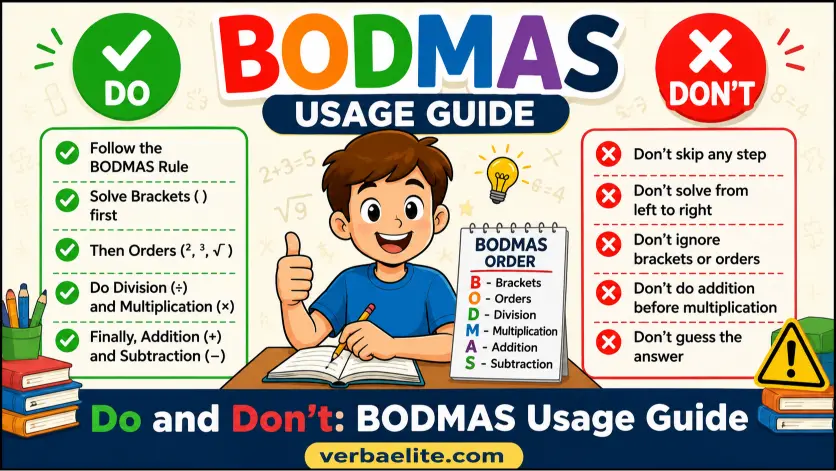
Do
- Do solve brackets first.
- Do handle powers and orders at the correct stage.
- Do evaluate multiplication and division from left to right.
- Do evaluate addition and subtraction from left to right.
- Do show your working in difficult problems.
- Do check the final answer.
Don’t
- Don’t automatically solve everything from left to right.
- Don’t assume multiplication always comes before division.
- Don’t ignore brackets.
- Don’t skip powers or roots.
- Don’t change the original expression while solving it.
- Don’t rely on memorization without understanding precedence.
BODMAS in Everyday Mathematics
You may not always notice it, but order of operations is relevant whenever several mathematical operations are combined.
For example, suppose a calculation represents a basic cost:
3 × 20 + 10
If three items cost 20 each and there is an additional 10-unit charge, multiplication should be completed first:
3 × 20 = 60
60 + 10 = 70
BODMAS helps keep the mathematical meaning of the expression clear.
Related Terms
If you are learning BODMAS, these related mathematical concepts are also worth understanding:
- Order of operations
- PEMDAS
- BIDMAS
- Arithmetic operations
- Brackets
- Parentheses
- Exponents
- Indices
- Powers
- Square roots
- Division
- Multiplication
- Addition
- Subtraction
- Mathematical expressions
- Algebraic expressions
- Simplification
FAQs:
1. What is the full form of BODMAS?
BODMAS stands for Brackets, Orders, Division, Multiplication, Addition, and Subtraction. It is a mnemonic used to remember the order of operations in mathematics. Brackets are handled first, followed by orders such as powers or roots, then division and multiplication from left to right, and finally addition and subtraction from left to right.
2. What does O stand for in BODMAS?
The O in BODMAS commonly stands for Orders. It refers to mathematical orders such as powers, indices, and related operations. For example, in 3² + 4, the power 3² is evaluated before the addition. Different educational resources may use slightly different terminology, but the underlying idea is the same: handle powers or equivalent higher-order operations at the appropriate stage.
3. What is the BODMAS rule?
The BODMAS rule is a method for deciding the sequence in which operations in a mathematical expression should be evaluated. It means Brackets, Orders, Division, Multiplication, Addition, and Subtraction. Division and multiplication have equal precedence and are normally evaluated from left to right. Addition and subtraction also share a level and are evaluated from left to right.
4. What is an easy example of BODMAS?
Consider 2 + 5 × 3. Multiplication comes before addition, so first calculate 5 × 3 = 15. Then add 2: 2 + 15 = 17. If you added first, you would get a different answer, which demonstrates why an agreed order of operations is necessary. BODMAS provides a systematic method for handling expressions with multiple operations.
5. Is multiplication always before division in BODMAS?
No. Multiplication and division have equal precedence. When both appear in the same expression at the same level, work from left to right. For example, 24 ÷ 4 × 2 becomes 6 × 2, giving 12. The BODMAS acronym places D before M as a memory sequence, but that does not mean division has higher mathematical precedence than multiplication.
6. Is BODMAS the same as PEMDAS?
BODMAS and PEMDAS are different mnemonics for the same general concept: order of operations. BODMAS uses Brackets and Orders, while PEMDAS commonly uses Parentheses and Exponents. Their terminology varies by educational system, but the underlying mathematical principle remains consistent: higher-priority operations are evaluated before lower-priority ones, with equal-priority operations handled from left to right.
7. Why is BODMAS important in mathematics?
BODMAS is important because it prevents confusion when an expression contains several operations. Without an agreed order, people could perform the same calculation differently and obtain different results. By following a standard sequence, students, teachers, and mathematicians can evaluate expressions consistently. It is therefore an important foundation for arithmetic, algebra, equations, and more advanced mathematical work.
8. Do brackets always come first in BODMAS?
Yes, brackets are normally evaluated before the other operations contained outside them. For example, in 5 × (4 + 2), solve 4 + 2 first to get 6, then multiply 5 × 6 to get 30. If brackets are nested, begin with the innermost brackets and work outward. This prevents the expression from being interpreted incorrectly.
9. What are Orders in BODMAS?
Orders refer to mathematical operations involving powers, exponents, indices, roots, and related notation. For example, 2³ is an order involving a power. In an expression such as 2³ + 5, calculate 2³ first to obtain 8, then add 5 to get 13. The exact terminology can vary between educational systems, but “Orders” is the common expansion of O in BODMAS.
10. How can students remember BODMAS easily?
Students can remember BODMAS by repeatedly associating each letter with its operation: Brackets, Orders, Division, Multiplication, Addition, Subtraction. The most important part is not merely memorizing the acronym but understanding that multiplication and division share priority, as do addition and subtraction. Practicing short expressions such as 5 + 2 × 3 and (5 + 2) × 3 can make the rule much easier to remember.
BODMAS Practice Questions
Try solving these without looking at the answers:
- 7 + 3 × 4
- (7 + 3) × 4
- 20 ÷ 5 + 6
- 18 − 2 × 5
- 3² + 6
- 30 ÷ 3 × 2
- 40 − (6 + 4) × 2
- 5 × (8 − 3) + 2
Answers
- 19
- 40
- 10
- 8
- 15
- 20
- 20
- 27
Conclusion:
The BODMAS full form is Brackets, Orders, Division, Multiplication, Addition, and Subtraction. It provides a simple way to remember the order in which mathematical operations should be evaluated.
The most important thing to remember is that division and multiplication have equal priority, so they are handled from left to right; the same applies to addition and subtraction.
Once you understand the principle rather than simply memorizing the acronym, complex-looking expressions become much easier to solve.
Practice with brackets, powers, multiplication, division, addition, and subtraction, and always show your working when an expression contains several steps.
BODMAS is ultimately a tool for making mathematical reasoning clear, consistent, and accurate.

I am Naqash Ayub, the content creator behind VerbaElite, where I simplify full forms, abbreviations, and their meanings into easy to understand explanations. My goal is to provide accurate, reader friendly, and well researched content that helps students, professionals, and everyday readers quickly find the information they need.