
If you’ve ever seen the abbreviation EMR in a hospital, clinic, or medical billing office, you may have wondered what it actually means.
While the term is commonly used in healthcare, many people confuse it with EHR or assume both are identical.
Understanding the EMR full form in medical billing is important because it plays a major role in patient documentation, coding, insurance claims, and reimbursement.
This guide explains everything in simple language, from its meaning and benefits to how it supports the medical billing process.
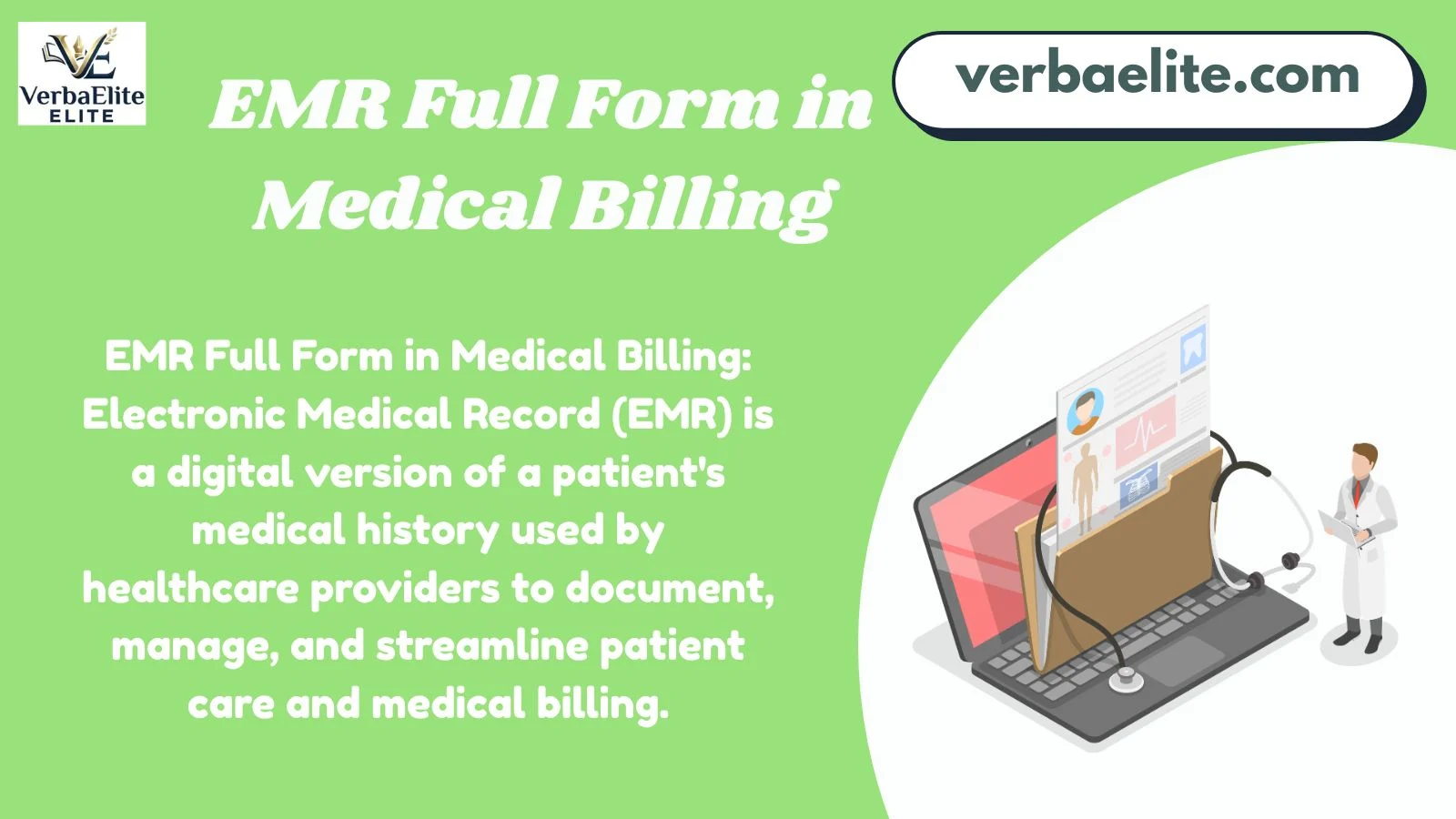
EMR stands for Electronic Medical Record in medical billing. It is a digital version of a patient’s medical chart that helps healthcare providers document patient information, improve billing accuracy, and streamline insurance claim processing.
An Electronic Medical Record (EMR) is a digital patient record used within a healthcare practice to document medical history, diagnoses, treatments, prescriptions, and clinical notes. In medical billing, EMRs improve documentation accuracy, support medical coding, reduce billing errors, and help healthcare providers process insurance claims efficiently.
What Is the EMR Full Form in Medical Billing?
The EMR full form in medical billing is Electronic Medical Record.
An Electronic Medical Record is a digital version of a patient’s paper chart maintained by a healthcare provider. It contains important medical information such as diagnoses, medications, treatment plans, allergies, laboratory results, physician notes, and medical history.
In medical billing, EMRs help healthcare professionals record patient encounters accurately, making it easier for medical coders and billers to assign the correct codes and submit insurance claims without errors.
Why Is EMR Important in Medical Billing?
Medical billing depends on accurate patient information. Even a small documentation mistake can lead to denied claims or delayed payments.
EMRs help by:
- Recording patient information digitally
- Documenting diagnoses and treatments accurately
- Supporting medical coding
- Reducing paperwork
- Improving communication among healthcare staff
- Minimizing billing mistakes
- Speeding up claim submission
- Maintaining complete patient records
- Supporting compliance with healthcare regulations
Without proper documentation, insurance companies may reject claims due to insufficient medical evidence.
How EMR Works in Medical Billing
The billing process begins when a patient visits a healthcare provider.
Step 1: Patient Registration
Patient demographic and insurance information is entered into the EMR.
Step 2: Clinical Documentation
The physician records symptoms, diagnosis, examination findings, medications, and treatment provided.
Step 3: Medical Coding
Certified coders review the EMR documentation and assign appropriate ICD-10, CPT, and HCPCS codes.
Step 4: Claim Creation
Medical billers use these codes to generate an insurance claim.
Step 5: Insurance Submission
The claim is electronically submitted to the insurance company.
Step 6: Payment Processing
The insurer reviews the documentation and reimburses the healthcare provider if everything is accurate.
Information Stored in an EMR
A typical Electronic Medical Record includes:
- Patient demographics
- Medical history
- Allergies
- Current medications
- Immunization records
- Vital signs
- Progress notes
- Physician observations
- Laboratory reports
- Imaging results
- Diagnoses
- Treatment plans
- Surgical history
- Follow-up appointments
- Billing documentation
This centralized information supports both clinical care and revenue cycle management.
Benefits of EMR in Medical Billing
Improves Documentation Accuracy
Electronic documentation reduces handwriting errors and missing information.
Faster Insurance Claims
Accurate patient records allow claims to be submitted more quickly.
Reduces Billing Errors
EMRs provide complete clinical documentation that supports correct coding.
Better Patient Care
Doctors can easily access previous medical history before treatment.
Higher Productivity
Healthcare staff spend less time searching for paper files.
Better Compliance
Electronic records help healthcare providers comply with HIPAA and other healthcare regulations.
Easier Data Retrieval
Authorized staff can instantly retrieve patient records when needed.
Lower Administrative Costs
Digital records reduce printing, storage, and paperwork expenses.
EMR vs EHR: What’s the Difference?
| Feature | EMR | EHR |
|---|---|---|
| Full Form | Electronic Medical Record | Electronic Health Record |
| Usage | Single healthcare practice | Multiple healthcare organizations |
| Data Sharing | Limited | Broad interoperability |
| Patient Information | Internal records | Shared across providers |
| Primary Purpose | Clinical documentation | Coordinated patient care |
| Medical Billing | Supports coding and billing | Supports billing and care coordination |
Simple Explanation
Think of an EMR as a patient’s digital chart inside one clinic, while an EHR allows that information to be securely shared among hospitals, specialists, pharmacies, and other healthcare providers.
Key Features of an EMR System
Modern EMR software typically includes:
- Electronic patient charts
- Appointment scheduling
- Prescription management
- Laboratory integration
- Medical coding support
- Clinical documentation
- Billing integration
- Insurance verification
- Secure messaging
- Reporting dashboards
- Patient history tracking
- Document management
Role of EMR in Medical Coding
Medical coders rely heavily on EMRs because coding requires complete clinical documentation.
EMRs help coders:
- Identify diagnoses
- Verify procedures performed
- Review physician notes
- Assign ICD-10 codes
- Assign CPT codes
- Assign HCPCS codes
- Reduce coding errors
- Support claim justification
Accurate coding directly affects reimbursement.
How EMR Improves Insurance Claims
Insurance companies require proof that medical services were medically necessary.
EMRs provide:
- Complete physician documentation
- Treatment history
- Diagnostic reports
- Procedure details
- Medication records
- Supporting clinical evidence
This documentation helps reduce claim denials and speeds up reimbursements.
Advantages of EMR
- Faster documentation
- Better patient safety
- Improved billing accuracy
- Reduced paperwork
- Better organization
- Easier record retrieval
- Increased productivity
- Improved communication
- Better compliance
- Lower operational costs
Challenges of EMR Systems
Although EMRs provide many benefits, they also present some challenges.
Common challenges include:
- High implementation costs
- Staff training requirements
- Data migration difficulties
- Cybersecurity concerns
- Temporary productivity loss during implementation
- Software maintenance costs
- Technical support needs
Despite these challenges, the long-term benefits generally outweigh the initial investment.
Real-Life Example of EMR in Medical Billing
A patient visits a family physician with a sore throat.
The physician records:
- Patient symptoms
- Physical examination
- Diagnosis
- Prescribed medication
- Follow-up instructions
The medical coder reviews the EMR and assigns the correct ICD-10 diagnosis code and CPT procedure code.
The billing department submits the insurance claim electronically.
Because the documentation is complete and accurate, the insurance company processes the claim quickly, resulting in faster reimbursement.
EMR Best Practices for Medical Billing
Healthcare organizations should:
- Document patient visits immediately
- Maintain accurate patient demographics
- Verify insurance information
- Update medication lists regularly
- Record diagnoses clearly
- Review documentation before coding
- Conduct routine audits
- Protect patient privacy
- Train staff regularly
- Keep software updated
These practices improve both patient care and revenue cycle efficiency.
Common Terms Related to EMR
- Electronic Health Record (EHR)
- Personal Health Record (PHR)
- Medical Billing
- Medical Coding
- ICD-10 Codes
- CPT Codes
- HCPCS Codes
- Revenue Cycle Management (RCM)
- Insurance Claims
- Clinical Documentation
- Practice Management System (PMS)
- Healthcare Information Technology
FAQs:
What is the EMR full form in medical billing?
EMR stands for Electronic Medical Record. It is a digital version of a patient’s medical chart used by healthcare providers to document clinical information and support medical billing.
What is the purpose of an EMR?
The primary purpose of an EMR is to store patient medical information electronically, improve documentation accuracy, support medical coding, and streamline insurance claim processing.
Is EMR the same as EHR?
No. An EMR is generally used within a single healthcare practice, while an EHR allows patient information to be securely shared across multiple healthcare organizations.
How does EMR help medical billing?
EMRs provide accurate clinical documentation that supports proper coding, reduces billing errors, minimizes claim denials, and speeds up reimbursement.
Who uses EMR systems?
Doctors, nurses, medical coders, billers, healthcare administrators, laboratories, and other authorized healthcare professionals use EMR systems.
Can EMRs reduce claim denials?
Yes. Complete documentation within an EMR helps ensure that insurance claims include the necessary clinical evidence, reducing the likelihood of denials.
What information is stored in an EMR?
An EMR stores patient demographics, medical history, diagnoses, medications, allergies, laboratory results, physician notes, treatment plans, and other clinical information.
Is EMR secure?
Most modern EMR systems use encryption, access controls, audit logs, and other security measures to protect patient information and comply with healthcare privacy regulations.
What are the benefits of EMR for healthcare providers?
EMRs improve efficiency, reduce paperwork, enhance patient safety, support accurate billing, improve communication, and simplify record management.
Why is EMR important in healthcare?
EMRs improve the quality of patient care while helping healthcare organizations maintain accurate documentation, comply with regulations, and optimize medical billing and reimbursement processes.
Conclusion:
Understanding the EMR full form in medical billing is essential for anyone working in healthcare, medical coding, or insurance claims.
An Electronic Medical Record serves as the foundation for accurate clinical documentation, efficient coding, and successful reimbursement.
By replacing paper records with secure digital documentation, EMRs improve patient care, reduce administrative workload, and help healthcare providers maintain compliance with industry standards.
Whether you are a student, healthcare professional, or simply exploring medical terminology, learning how EMRs support the billing process provides valuable insight into today’s modern healthcare system.

I am Naqash Ayub, the content creator behind VerbaElite, where I simplify full forms, abbreviations, and their meanings into easy to understand explanations. My goal is to provide accurate, reader friendly, and well researched content that helps students, professionals, and everyday readers quickly find the information they need.