

What does POS actually mean? The answer depends on where you saw it at a store, in English grammar, in cryptocurrency, or on a form.
Although POS is a short abbreviation, it has several important meanings.
Let’s break down the most common POS full forms in simple language.
POS Full Form
The most common full form of POS in business and retail is Point of Sale. It refers to the place or system where a customer completes a purchase and payment.
However, POS can have different full forms depending on the subject. In English grammar, POS commonly means Part of Speech, while in cryptocurrency it can mean Proof of Stake.
Quick Answer: POS Full Form
POS most commonly stands for “Point of Sale,” the place or system where a customer pays for goods or services.
| POS Full Form | Field | Meaning |
|---|---|---|
| Point of Sale | Business/Retail | Place or system where a transaction occurs |
| Part of Speech | English Grammar | Category of a word based on its grammatical function |
| Proof of Stake | Cryptocurrency | A blockchain consensus mechanism |
| Position | General/Technical | A person’s or object’s place or status |
What Is POS?
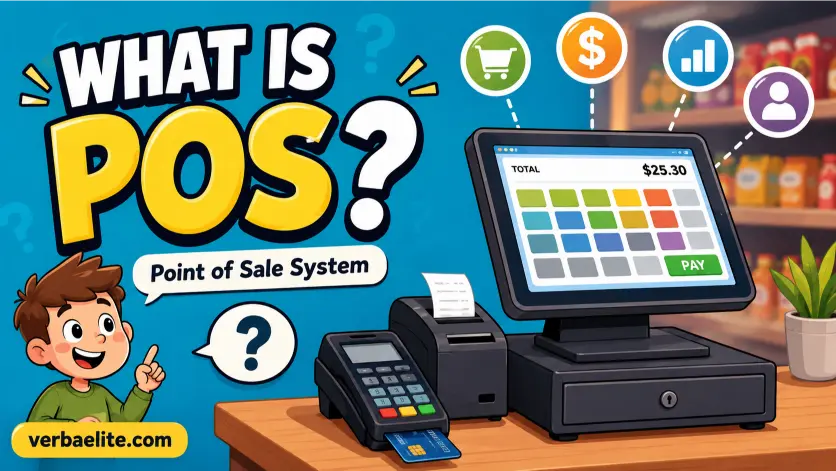
POS is an abbreviation whose meaning changes according to context. The most widely recognized business meaning is Point of Sale, which describes the point where a customer purchases a product or service and makes a payment.
A POS system can include hardware and software such as a cash register, barcode scanner, receipt printer, payment terminal, inventory system, and sales software.
In other contexts, POS can mean Part of Speech in grammar or Proof of Stake in blockchain technology.
Therefore, the correct POS full form depends on the subject in which the abbreviation is being used.
1. POS Full Form: Point of Sale
Point of Sale is the most common meaning of POS in retail, restaurants, supermarkets, and other businesses.
A point of sale is where a customer completes a purchase. Traditionally, this could simply mean a cash counter. Today, the term usually refers to a computerized POS system that processes sales and manages related business information.
Example
Imagine you walk into a clothing store and select a shirt.
At the checkout counter, the employee scans the shirt, the system calculates the price, you make a payment, and you receive a receipt.
That entire transaction takes place through the store’s Point of Sale (POS) system.
What Does a POS System Do?
A modern POS system can perform several tasks, including:
- Processing customer payments
- Calculating the total price
- Printing or sending receipts
- Recording sales
- Tracking inventory
- Applying discounts
- Managing product information
- Generating sales reports
- Supporting different payment methods
- Helping businesses monitor transactions
POS Example in a Sentence
“The cashier entered the customer’s order into the POS system.”
Here, POS means Point of Sale.
2. POS Full Form: Part of Speech
In English grammar, POS can stand for Part of Speech.
A part of speech identifies the grammatical category or role of a word in a sentence. Common parts of speech include nouns, pronouns, verbs, adjectives, adverbs, prepositions, conjunctions, and interjections.
Example
Consider this sentence:
“The clever boy quickly opened the door.”
The words have different grammatical roles:
- The — determiner
- clever — adjective
- boy — noun
- quickly — adverb
- opened — verb
- the — determiner
- door — noun
In a grammar lesson, a teacher may ask for the POS of a particular word. In that context, POS means Part of Speech, not Point of Sale.
Why Is Part of Speech Important?
Understanding parts of speech helps students:
- Build grammatically correct sentences
- Identify the function of words
- Improve vocabulary
- Understand sentence structure
- Write more clearly
- Analyze English grammar
3. POS Full Form: Proof of Stake
In cryptocurrency and blockchain technology, POS commonly means Proof of Stake.
Proof of Stake is a blockchain consensus mechanism used to help validate transactions and maintain network security.
Instead of relying on traditional mining methods, Proof of Stake allows participants to help validate transactions by committing, or “staking,” cryptocurrency according to the rules of a particular blockchain network.
Simple Example
Suppose a blockchain uses Proof of Stake. Participants may lock or stake cryptocurrency to participate in network validation. The network uses its protocol to select validators and confirm transactions.
In this context:
POS = Proof of Stake
POS in Cryptocurrency
When you see terms such as:
- POS blockchain
- POS consensus
- POS validator
- POS staking
- Proof of Stake
the abbreviation is referring to Proof of Stake.
This meaning is completely different from Point of Sale in retail.
4. POS Full Form: Position
In some contexts, POS may be used as an abbreviation for Position.
For example, a form, table, sports record, organizational chart, or technical document may use “POS” to indicate someone’s or something’s position.
Example
A sports table might contain a column labeled:
POS | Team | Points
Here, POS may mean Position, indicating the team’s rank in the table.
Because abbreviations vary between industries and organizations, the surrounding context is important.
POS Full Form by Context
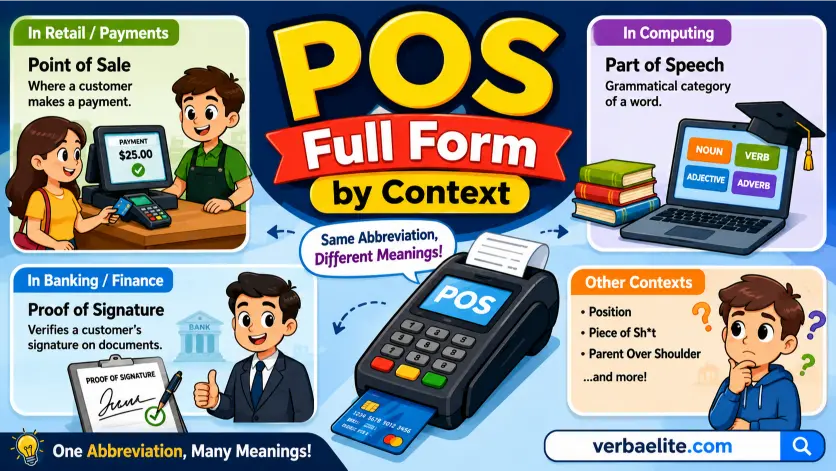
The easiest way to understand POS is to look at the subject where you encountered it.
| Context | POS Full Form | Simple Meaning |
| Retail | Point of Sale | Place/system where a purchase is completed |
| Business | Point of Sale | Sales and payment system |
| Grammar | Part of Speech | Grammatical category of a word |
| Cryptocurrency | Proof of Stake | Blockchain consensus mechanism |
| Sports/General | Position | Rank, place, or location |
| Technology | Point of Sale | Digital system used for transactions |
POS in Retail: How Does It Work?
A POS transaction generally follows a simple process:
Product selection → Product scanning → Price calculation → Payment → Receipt → Sales record
For example, in a supermarket, the cashier scans a product’s barcode. The POS system identifies the item and price, calculates the customer’s total, processes the payment, and records the transaction.
Modern systems may also automatically update inventory after a sale.
This makes POS technology useful for both customers and businesses.
POS Full Form in Banking
- POS stands for Point of Sale in banking
- It refers to a place where customers make payments for goods or services
- POS transactions can be completed using cards or digital payment methods
- Banks process POS payments through connected payment networks
- POS terminals are commonly available at retail stores and businesses
- Customers can pay by inserting, tapping, or swiping a card
- POS systems help merchants accept electronic payments
- A successful POS transaction usually generates a payment receipt
- POS payments can be linked to a customer’s bank account
- Banks may charge merchants fees for POS transaction services
- POS transactions provide a convenient alternative to cash payments
- Transaction details are generally recorded electronically
- POS banking services support faster and more secure payment processing
- POS technology is widely used in modern retail and commercial banking
POS Full Form Slang
- POS can have a different meaning when used as slang
- In informal communication, POS can mean piece of shit
- This slang expression is considered rude and offensive
- It is generally used to strongly insult a person or thing
- The meaning depends heavily on the surrounding conversation
- POS slang is common in texting and online conversations
- It should not be confused with Point of Sale
- Context is important when interpreting the abbreviation
- The slang meaning is usually used in casual or emotional conversations
- It may appear on social media, forums, or private messages
- Professional communication should avoid this usage
- POS can sometimes be written in lowercase as pos
- The slang interpretation has no connection with banking terminology
- Always check the context before deciding what POS means
POS Full Form in Credit Card
- POS stands for Point of Sale in credit card terminology
- A POS transaction occurs when a credit card is used to make a purchase
- The transaction is processed through a merchant’s POS terminal
- Customers can often tap, insert, or swipe their credit card
- The terminal sends transaction information for authorization
- The card issuer checks whether the transaction can be approved
- Approved transactions are recorded as credit card purchases
- POS payments are commonly used in shops, restaurants, and supermarkets
- A POS transaction may require a PIN or other verification
- Contactless credit card payments can also be processed through POS terminals
- The merchant receives payment through the card payment network
- The customer receives a transaction record or receipt
- POS credit card payments reduce the need to carry cash
- These transactions are a major part of everyday card payments
POS Full Form in Payment
- POS means Point of Sale in payment systems
- It describes the location or system where a payment is made
- POS payments allow customers to pay merchants electronically
- Debit cards and credit cards can be used for POS payments
- Contactless payment is also commonly supported by modern POS terminals
- The payment terminal captures the required transaction information
- The transaction is sent to the relevant payment network
- The customer’s payment method is checked and authorized
- Successful payments are confirmed by the POS system
- POS payments are widely used in physical retail locations
- Merchants can receive electronic records of completed transactions
- POS systems can sometimes support digital wallets and QR payments
- Electronic POS payments can make checkout faster
- POS technology helps businesses manage everyday payment transactions
POS Hardware and Software
A traditional POS setup may contain several physical components.
Common POS Hardware
- Computer or touchscreen terminal
- Barcode scanner
- Receipt printer
- Cash drawer
- Card payment terminal
- Customer display
- Weighing scale in some stores
Common POS Software Features
POS software may provide:
- Product management
- Inventory tracking
- Sales reporting
- Employee management
- Discount management
- Customer records
- Payment processing
- Business analytics
The exact features depend on the POS provider and type of business.
POS vs. Traditional Cash Register
A cash register mainly records sales and stores cash. A modern POS system can do much more.
| Feature | Cash Register | POS System |
| Records sales | Yes | Yes |
| Processes payments | Yes | Yes |
| Inventory tracking | Limited | Usually available |
| Sales reports | Limited | Advanced |
| Customer information | Usually limited | Often available |
| Digital integration | Limited | Extensive |
Therefore, a POS system is generally a more comprehensive business tool than a basic cash register.
How to Identify the Correct POS Full Form
When you encounter the abbreviation POS, look at the surrounding words.
If you see:
POS machine, POS terminal, POS system, POS software
→ It most likely means Point of Sale.
If you see:
POS grammar, POS tagging, POS noun, POS verb
→ It means Part of Speech.
If you see:
POS blockchain, POS validator, POS staking
→ It means Proof of Stake.
If you see:
POS rank, POS number, POS column
→ It may mean Position.
This context-based approach prevents confusion.
POS in Natural Sentences
Here are examples showing how POS is used in different contexts:
- “The restaurant installed a new POS system.”
Here, POS means Point of Sale. - “The cashier processed the payment through the POS terminal.”
POS means Point of Sale. - “Identify the POS of the underlined word.”
POS means Part of Speech. - “The teacher explained POS tagging in the grammar lesson.”
POS means Part of Speech. - “The blockchain uses a POS consensus mechanism.”
POS means Proof of Stake. - “The team moved into first POS after the final match.”
POS can mean Position in this context.
POS vs. POS System
Although people often use POS and POS system interchangeably, they can have slightly different meanings.
POS is the abbreviation for Point of Sale.
A POS system is the collection of hardware and software used to manage sales transactions at that point.
For example:
POS: Point of Sale
POS system: Technology used to process and manage sales at the point of sale.
Why Is POS Important for Businesses?
POS technology has become an important part of modern retail and service businesses because it combines payment processing with sales information.
A business can use a POS system to understand what products are selling, record transactions, manage inventory, and generate useful reports.
For customers, POS systems can make checkout faster and support payment options such as cards and digital payments.
For businesses, the main benefit is the ability to manage sales operations more efficiently.
POS in Education and English Grammar
Students commonly encounter POS while studying English grammar or computational linguistics.
In basic grammar, identifying a word’s part of speech helps explain how that word functions in a sentence.
For example:
“Sara runs quickly.”
- Sara → noun
- runs → verb
- quickly → adverb
A student may be asked to identify the POS of each word.
In natural language processing, POS tagging refers to assigning grammatical categories to words in text. This is useful in computational linguistics and language-processing applications.
POS Full Form: Quick Comparison
| Full Form | What It Means | Common Area |
| Point of Sale | A place/system for completing transactions | Retail & Business |
| Part of Speech | Grammatical category of a word | English |
| Proof of Stake | Blockchain consensus mechanism | Cryptocurrency |
| Position | Place, rank, or status | General/Sports |
Common Mistakes About POS
1. Assuming POS Always Means Point of Sale
Point of Sale is one of the most common meanings, but it is not the only one. Always consider the context.
2. Confusing Part of Speech With Point of Sale
If you are studying grammar, POS almost certainly refers to Part of Speech.
3. Confusing Proof of Stake With Point of Sale
In cryptocurrency discussions, POS normally means Proof of Stake.
4. Ignoring the Words Around the Abbreviation
The surrounding terminology usually reveals which POS meaning is intended.
Do and Don’t When Using POS
Do
- Check the subject or industry.
- Expand POS when introducing it in formal writing.
- Use context to determine its meaning.
- Explain the abbreviation when your audience may not know it.
Don’t
- Assume POS has only one full form.
- Use the abbreviation without context in confusing situations.
- Treat the grammar meaning as the same as the retail meaning.
- Assume every technical use refers to Point of Sale.
POS Full Form in Chat and Everyday Conversation
Here are some natural examples:
“What does POS mean in this invoice?”
→ It probably means Point of Sale.
“What is the POS of this word?”
→ It means Part of Speech.
“Is this blockchain based on POS?”
→ It means Proof of Stake.
“Check the POS column.”
→ It may mean Position.
The context tells you which meaning is correct.
POS Full Form in Accounting
- POS stands for Point of Sale in accounting
- It refers to the system used to record sales transactions
- POS systems can automatically record the value of completed sales
- Sales data can be transferred into accounting or bookkeeping systems
- POS records may include sales amounts, taxes, discounts, and payment methods
- Businesses can use POS data to monitor daily revenue
- Inventory information can also be connected with POS records
- POS systems help reduce manual entry of sales information
- Accounting teams can use transaction reports for financial reconciliation
- POS data can help businesses track cash and electronic payments
- Sales records can support preparation of financial reports
- POS systems are especially useful for retail and restaurant businesses
- Accurate POS records can improve transaction tracking
- POS accounting integration can make financial management more efficient
POS Full Form in Computer
- POS stands for Point of Sale in computer technology
- A POS system is a computer-based setup used to process sales
- It can include a computer, monitor, scanner, printer, and payment terminal
- POS software manages sales and transaction information
- Barcode scanners can be connected to POS computers
- POS systems can store product and pricing information
- They can calculate totals, taxes, discounts, and change
- Payment terminals can connect with the computer-based POS system
- POS software can generate sales reports
- Some systems also manage inventory information
- Businesses can use POS computers to organize checkout operations
- Cloud-based POS systems can synchronize information across locations
- Security features help protect transaction and customer information
- Computerized POS systems make retail operations faster and more organized
POS Full Form in Debit Card
- POS stands for Point of Sale when referring to debit card transactions
- A POS debit transaction happens when a debit card is used for payment
- The transaction usually takes place at a merchant’s payment terminal
- The amount is generally deducted from the customer’s linked bank account
- Customers can insert, swipe, or tap their debit card
- Some transactions require a PIN for verification
- The bank checks the account before approving the transaction
- A successful transaction reduces the available account balance
- POS debit payments are common in stores and supermarkets
- Customers may receive a printed or digital receipt
- POS transactions provide an electronic record of the purchase
- Debit card POS payments reduce the need for physical cash
- Contactless debit cards can work with compatible POS terminals
- POS debit transactions provide a convenient way to pay directly from a bank account
POS Full Form in Microfinance
- POS can stand for Point of Sale in microfinance payment services
- POS systems can help microfinance institutions process customer payments
- They may be used for collecting repayments through electronic channels
- Customers can make certain payments using cards or other supported methods
- POS technology can reduce reliance on cash-based transactions
- Electronic transactions can create digital records of payments
- Microfinance organizations can use transaction records for monitoring
- POS systems may support financial services delivered through agents
- They can help improve the speed of payment collection
- Digital payment records can make reconciliation easier
- POS services can support financial inclusion in some markets
- Agents may use POS devices to provide basic financial services
- Transaction data can help institutions maintain accurate customer records
- POS technology can make microfinance payment operations more efficient
FAQs:
What is the full form of POS?
The most common full form of POS is Point of Sale. It refers to the place or system where a customer completes a purchase and payment. However, POS has several meanings depending on context. In English grammar, it can mean Part of Speech, while in cryptocurrency it commonly means Proof of Stake.
What does POS mean in business?
In business and retail, POS means Point of Sale. It refers to the location or technology used to complete a customer transaction. A modern POS system can process payments, record sales, manage inventory, print receipts, apply discounts, and generate business reports.
What is POS in English grammar?
In English grammar, POS stands for Part of Speech. It describes the grammatical category or function of a word, such as noun, verb, adjective, adverb, pronoun, preposition, conjunction, or interjection.
What is the POS full form in cryptocurrency?
In cryptocurrency and blockchain technology, POS commonly stands for Proof of Stake. It is a consensus mechanism that allows blockchain networks to validate transactions using participants who stake cryptocurrency according to the network’s protocol.
What does POS mean in a POS machine?
In a POS machine, POS means Point of Sale. The machine is part of a system that helps a business complete customer transactions. Depending on the setup, it may process card or digital payments, calculate totals, print receipts, and record sales.
What are examples of POS systems?
Examples of POS systems include checkout systems used in supermarkets, restaurants, clothing stores, cafés, pharmacies, and other retail businesses. A POS setup may include a touchscreen terminal, barcode scanner, receipt printer, cash drawer, payment terminal, and business management software.
Is POS the same as a cash register?
Not exactly. A cash register primarily records sales and handles payments, while a modern POS system can provide broader business functions. These may include inventory management, sales analytics, customer information, employee management, digital receipts, and integration with other business tools.
Why is POS important in English grammar?
POS, meaning Part of Speech, is important because it helps students understand how words function within sentences. Identifying whether a word is a noun, verb, adjective, adverb, or another grammatical category makes sentence structure and English grammar easier to understand.
What is POS tagging?
POS tagging, or Part-of-Speech tagging, is the process of assigning grammatical categories to words in a sentence or text. For example, a system may identify one word as a noun and another as a verb. POS tagging is widely used in natural language processing and computational linguistics.
Why does POS have different full forms?
POS is an abbreviation used across different industries and subjects. Abbreviations often develop separate meanings in different fields. Therefore, POS can mean Point of Sale in retail, Part of Speech in grammar, Proof of Stake in blockchain, or Position in certain general and technical contexts.
Conclusion:
The POS full form depends on the context in which the abbreviation is used. The most common business meaning is Point of Sale, referring to the place or system where a transaction is completed.
In English grammar, POS means Part of Speech, while in cryptocurrency it commonly means Proof of Stake. In some contexts, POS can also represent Position.
The key is simple: never interpret POS without checking the surrounding context. If you are talking about a store or payment terminal, Point of Sale is likely correct.
If you are discussing grammar, it means Part of Speech. In blockchain discussions, it means Proof of Stake. Understanding these differences makes the abbreviation much easier to recognize and use correctly.

I am Naqash Ayub, the content creator behind VerbaElite, where I simplify full forms, abbreviations, and their meanings into easy to understand explanations. My goal is to provide accurate, reader friendly, and well researched content that helps students, professionals, and everyday readers quickly find the information they need.