
Have you ever seen 500 PPM on a water report or 400 PPM in a scientific measurement and wondered what the number actually means?
The answer is simple: PPM helps describe a very small amount of one substance mixed with another.
Let’s understand the PPM full form, its meaning, formula, calculation, and real-life uses in simple words.
PPM full form is Parts Per Million. It is a unit used to express the concentration of a substance, meaning how many parts of that substance are present in one million parts of a total mixture.
PPM, or Parts Per Million, is a concentration measurement that shows the amount of one substance present in one million parts of a mixture. It is commonly used in science, water testing, air quality, chemistry, environmental monitoring, and industrial applications to measure very small quantities accurately.
What Is the Full Form of PPM?
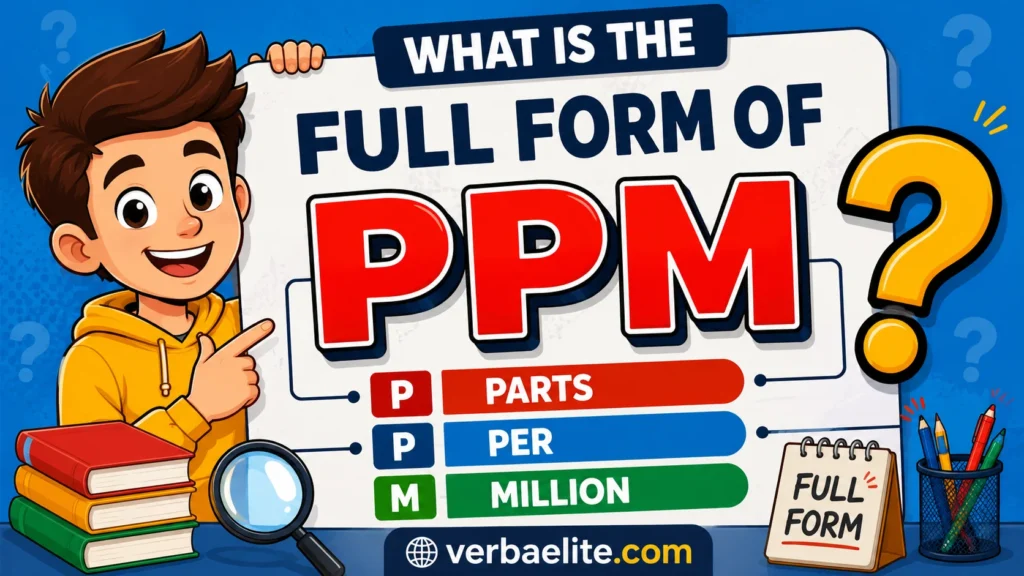
PPM stands for Parts Per Million.
It is commonly used to measure small concentrations of substances in liquids, gases, and other mixtures. PPM tells us how much of one substance exists compared with a total of one million parts.
For example, 1 PPM means:
1 part of a substance is present in 1,000,000 parts of the total mixture.
PPM is widely used in:
- Water quality testing
- Air pollution measurement
- Chemistry
- Environmental science
- Agriculture
- Food production
- Aquariums
- Industrial processes
- Laboratories
The basic idea is simple: the higher the PPM value, the greater the concentration of the measured substance.
PPM Meaning in Simple Words
Imagine you have one million tiny pieces of something.
If only one piece is a particular substance, its concentration is 1 PPM. If 100 pieces are that substance, the concentration is 100 PPM.
This makes PPM useful when the quantity is too small to describe conveniently with ordinary percentages.
Simple comparison
- 1% = 10,000 PPM
- 0.1% = 1,000 PPM
- 0.01% = 100 PPM
- 0.001% = 10 PPM
- 0.0001% = 1 PPM
So, PPM is especially helpful for measuring trace amounts.
PPM Formula
The standard formula for calculating PPM is:
PPM = (Amount of Solute ÷ Total Amount of Solution) × 1,000,000
Where:
- Solute = the substance being measured
- Solution or total mixture = the complete amount containing that substance
Example
Suppose a sample contains:
- 2 grams of a substance
- 1,000,000 grams of total material
Then:
PPM = (2 ÷ 1,000,000) × 1,000,000
PPM = 2
Therefore, the concentration is 2 PPM.
How Does PPM Work?
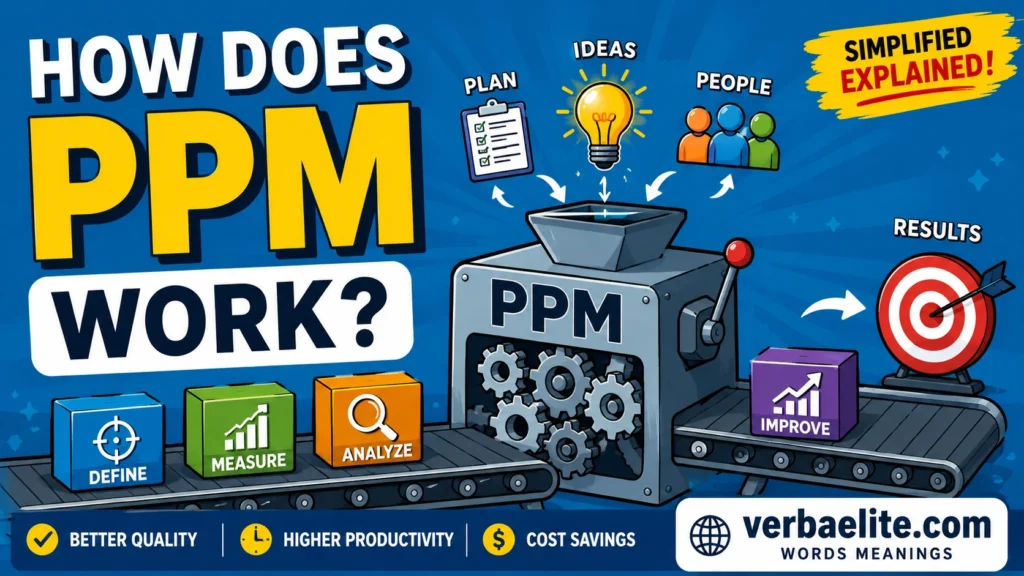
PPM works by comparing a small amount of a substance with the total amount of a mixture.
For example, imagine adding a tiny amount of salt to a large amount of water. Instead of using an extremely long decimal, scientists can express the concentration in PPM.
This makes measurements:
- Easier to read
- Easier to compare
- More practical in scientific reports
- Useful for detecting trace substances
- Convenient for environmental standards
PPM can represent concentration based on different measurements, including:
- Mass per mass
- Volume per volume
- Mass per volume
The exact interpretation depends on the substance and measurement context.
PPM Full Form in Water
In water testing, PPM usually refers to the amount of dissolved substances present in water.
One common example is TDS, which stands for Total Dissolved Solids. A TDS meter may display a result in PPM to indicate the approximate concentration of dissolved minerals and other substances.
For water, PPM may be used to measure:
- Dissolved minerals
- Chlorine
- Fluoride
- Nitrates
- Contaminants
- Salts
- Other dissolved substances
Important note
A PPM reading by itself does not automatically determine whether water is safe or unsafe. Safety depends on which substance is being measured and the applicable health or environmental standard.
For example, 50 PPM of one substance may be acceptable in a particular situation, while 50 PPM of another substance could require concern or further testing.
PPM Full Form in Chemistry
In chemistry, Parts Per Million is used to express very low concentrations.
Scientists often work with substances that are present in tiny amounts. PPM provides a convenient way to communicate these concentrations without using long decimal numbers.
For example:
- A chemical may be present at 5 PPM.
- A contaminant may be detected at 20 PPM.
- A dissolved compound may have a concentration of 100 PPM.
This helps researchers compare samples and report measurements clearly.
PPM Full Form in Air Pollution
PPM is also used to measure the concentration of certain gases in the air.
For example, environmental monitoring may measure gases such as:
- Carbon monoxide
- Nitrogen-containing gases
- Other atmospheric pollutants
In this context, PPM describes how many parts of a gas are present per million parts of air.
For example, 10 PPM of a gas means approximately 10 parts of that gas exist for every one million parts of the air mixture, depending on the measurement basis being used.
Air-quality measurements may also use other units, such as PPB (Parts Per Billion), especially when concentrations are even smaller.
PPM Full Form in Agriculture
In agriculture, PPM is often used to monitor the concentration of nutrients and substances in water or growing solutions.
For example, growers may measure the concentration of dissolved nutrients supplied to plants.
PPM can help monitor:
- Nutrient solutions
- Fertilizer concentration
- Mineral levels
- Water quality
However, the ideal PPM level depends on factors such as the plant type, growth stage, growing method, and specific substances being measured.
PPM Full Form in an Aquarium
Aquarium owners may encounter PPM when checking water conditions.
Different substances can be measured at different concentrations, including:
- Total dissolved solids
- Nitrates
- Minerals
- Salinity-related measurements
Maintaining suitable water conditions is important because fish and other aquatic organisms can be sensitive to changes in their environment.
Again, the number must always be interpreted according to what is being measured. There is no single “perfect PPM” for every aquarium.
PPM Meaning in Different Contexts
| Context | Meaning of PPM | Use Case | Example |
|---|---|---|---|
| Chemistry | Parts Per Million | Measuring small concentrations | A chemical is present at 25 PPM |
| Water Testing | Concentration of a substance in water | Checking dissolved materials | Water contains 100 PPM of a measured substance |
| Air Quality | Concentration of gas in air | Pollution monitoring | A gas concentration is measured in PPM |
| Agriculture | Concentration of dissolved nutrients | Managing nutrient solutions | Nutrients are monitored using a PPM reading |
| Aquarium | Concentration of substances in water | Water condition monitoring | Mineral levels are checked using concentration measurements |
| Industry | Trace concentration measurement | Quality control and processing | A substance must remain below a specified PPM level |
Common PPM Examples
1. 1 PPM
Meaning: One part of a substance exists in one million parts of the total mixture.
Simple explanation: This represents an extremely small concentration.
2. 10 PPM
Meaning: Ten parts of a substance are present in one million total parts.
Simple explanation: The concentration is ten times higher than 1 PPM.
3. 100 PPM
Meaning: One hundred parts of the measured substance are present in one million parts of the mixture.
Simple explanation: This is equal to 0.01%.
4. 500 PPM
Meaning: Five hundred parts of a substance exist per one million parts of the total mixture.
Simple explanation: The substance is still less than one percent of the mixture.
5. 1,000 PPM
Meaning: One thousand parts of a substance are present per one million parts.
Simple explanation: 1,000 PPM equals 0.1%.
6. 10,000 PPM
Meaning: Ten thousand parts of a substance exist per one million parts.
Simple explanation: 10,000 PPM equals 1%.
7. 50 PPM in Water
Meaning: The measured substance has a concentration of 50 parts per million.
Category: Water testing
Clarity: To understand whether this level is acceptable, you must know exactly which substance is being measured.
8. 25 PPM of a Chemical
Meaning: The chemical is present at a trace concentration of 25 parts per million.
Category: Chemistry
Clarity: PPM makes small chemical concentrations easier to report.
9. 5 PPM of a Gas
Meaning: The gas concentration is measured as five parts per million.
Category: Air monitoring
Clarity: PPM is commonly used for expressing low concentrations of certain gases.
10. 200 PPM Nutrient Solution
Meaning: The solution contains a measured concentration expressed as 200 parts per million.
Category: Agriculture
Clarity: The correct level depends on the nutrient, crop, and growing conditions.
11. 750 PPM Dissolved Material
Meaning: A measured dissolved substance or group of substances is reported at 750 parts per million.
Category: Water analysis
Clarity: The PPM value must be interpreted according to the testing method and substance involved.
12. 0.5 PPM
Meaning: Half of one part exists per one million parts of the total mixture.
Category: Trace measurement
Clarity: PPM can also express concentrations below one whole part per million.
PPM vs Percentage
Many people confuse PPM with percentage, but they represent different scales.
The relationship is:
1% = 10,000 PPM
Here are some useful conversions:
| Percentage | PPM |
| 1% | 10,000 PPM |
| 0.5% | 5,000 PPM |
| 0.1% | 1,000 PPM |
| 0.01% | 100 PPM |
| 0.001% | 10 PPM |
| 0.0001% | 1 PPM |
Easy way to remember
To convert percentage to PPM, multiply by 10,000.
To convert PPM to percentage, divide by 10,000.
PPM vs PPB
PPM means Parts Per Million, while PPB means Parts Per Billion.
The difference is the size of the measurement scale.
- 1 PPM = 1 part per 1,000,000
- 1 PPB = 1 part per 1,000,000,000
Because one billion is much larger than one million, PPB is used for measuring even smaller concentrations.
Also:
1 PPM = 1,000 PPB
How to Calculate PPM: Step-by-Step
Follow these simple steps.
Step 1: Find the amount of the substance
Identify the amount of the material you want to measure.
Step 2: Find the total amount
Determine the total quantity of the mixture or solution.
Step 3: Divide
Divide the amount of the measured substance by the total amount.
Step 4: Multiply by 1,000,000
Multiply the result by one million.
Formula
PPM = (Part ÷ Whole) × 1,000,000
Calculation example
Suppose 3 units of a substance are present in 600,000 units of a mixture:
PPM = (3 ÷ 600,000) × 1,000,000
PPM = 5
Therefore, the concentration is 5 PPM.
Why Is PPM Important?
PPM is important because many substances affect a system even when present in very small amounts.
A measurement in PPM can help with:
- Detecting trace substances
- Monitoring water quality
- Measuring chemical concentrations
- Environmental testing
- Industrial quality control
- Scientific research
- Agricultural management
Without small-scale units such as PPM, reporting tiny concentrations would often require complicated decimal values.
PPM creates a simple, standardized way to communicate those measurements.
✍️ How to Use PPM Correctly
When using PPM in writing, assignments, laboratory reports, or scientific discussions, clarity is essential.
1. Mention the full form first
Write:
PPM (Parts Per Million)
After that, you can use PPM throughout the text.
2. Identify what is being measured
Do not simply write:
The level is 100 PPM.
A clearer statement is:
The concentration of the measured substance is 100 PPM.
3. Explain the measurement context
PPM can have different practical interpretations depending on whether you are discussing water, air, chemicals, or another mixture.
4. Use the correct formula
Make sure the measured part and total mixture are expressed using compatible units before calculating.
5. Avoid treating every PPM value the same
The importance of a PPM reading depends on the substance being measured. Always consider the context and relevant standards.
❌ Common Mistakes About PPM
Confusing PPM with percentage
PPM is not the same as a percentage. Remember:
1% = 10,000 PPM
Forgetting the total mixture
PPM always involves a comparison between a part and the complete amount.
Ignoring the measured substance
A number such as 50 PPM has limited meaning unless you know 50 PPM of what.
Using incompatible units
Calculations can be incorrect if the amount of the substance and total mixture are not converted into compatible units.
Assuming a high or low number is automatically good or bad
Whether a PPM level is acceptable depends on the substance, context, measurement method, and applicable guidelines.
👍 PPM Usage Guide: Do and Don’t
Do
- Use Parts Per Million for small concentrations.
- Write the full form when introducing PPM.
- Identify the substance being measured.
- Use the formula correctly.
- Check the context before interpreting a reading.
- Use compatible units in calculations.
Don’t
- Confuse PPM with percent.
- Assume all PPM values measure the same thing.
- Call a reading safe or unsafe without knowing the substance.
- Ignore the total amount in the formula.
- Use PPM when another concentration unit is more appropriate for the situation.
💬 Natural Chat-Style Examples Using PPM
- “My water meter shows 250 PPM, but I need to know what the reading actually represents.”
- “PPM simply means how much of something is present in a million parts of a mixture.”
- “This chemical is present at only 2 PPM, so the concentration is very small.”
- “Check what substance the 100 PPM reading refers to before deciding whether the level is normal.”
- “One thousand PPM equals 0.1%, which makes the conversion easier to understand.”
- “The lab report uses PPM because the amount being measured is too small to express conveniently as a percentage.”
🔁 Related Terms
Parts Per Billion (PPB)
A smaller concentration unit representing one part of a substance per one billion parts of a mixture.
Concentration
The amount of a substance present within a specific quantity of a mixture or solution.
Total Dissolved Solids (TDS)
A measurement related to dissolved substances in water and often displayed by TDS meters using PPM-style readings.
Percentage
A value expressed per hundred. One percent equals 10,000 PPM.
Molarity
A chemistry concentration unit based on the number of moles of solute in a specified volume of solution.
Parts Per Thousand (PPT)
A concentration unit representing parts of a substance per one thousand parts of a mixture.
FAQ:
What is the PPM full form?
PPM full form is Parts Per Million. It is a unit used to measure the concentration of a substance in a mixture. One PPM means one part of a substance is present in one million parts of the total mixture. It is commonly used in water testing, chemistry, air monitoring, agriculture, laboratories, and industrial processes.
What does 1 PPM mean?
1 PPM means one part per one million parts. In simple terms, if a mixture contains one million equal parts, only one of those parts represents the substance being measured. It equals 0.0001% and is useful for describing extremely small concentrations without using long decimal numbers.
How do you calculate PPM?
PPM is calculated by dividing the amount of the measured substance by the total amount of the mixture and multiplying by one million. The formula is: PPM = (Part ÷ Whole) × 1,000,000. The units should be compatible before performing the calculation to avoid an incorrect result.
What is 100 PPM?
100 PPM means 100 parts of a measured substance are present in one million parts of the total mixture. It is equivalent to 0.01%. However, whether 100 PPM is high, low, safe, or unsafe depends entirely on what substance is being measured and the specific context.
What is 1,000 PPM in percentage?
1,000 PPM equals 0.1%. Since 1% equals 10,000 PPM, dividing 1,000 by 10,000 gives 0.1%. This conversion is useful when comparing scientific concentration values with percentages used in everyday calculations and product information.
Is PPM used for water?
Yes, PPM is commonly used in water testing. It can describe the concentration of dissolved materials or specific substances in water. However, a PPM value should always be interpreted together with the name of the substance and the testing method because different substances have different significance and recommended limits.
What is the difference between PPM and PPB?
PPM means Parts Per Million, while PPB means Parts Per Billion. PPB measures much smaller concentrations because one billion is one thousand times larger than one million. Therefore, 1 PPM equals 1,000 PPB. PPB is often useful when scientists need to measure extremely tiny trace quantities.
Why is PPM important in chemistry?
PPM is important because chemistry often involves very small concentrations of substances. It provides a simple way to report and compare trace amounts without writing long decimal numbers. PPM is especially useful in chemical analysis, environmental testing, quality control, and experiments involving low concentrations of compounds or contaminants.
Can students use PPM in school assignments?
Yes, students can use PPM when discussing concentration, chemistry, environmental science, water quality, or pollution. A good assignment explanation should define PPM as Parts Per Million, explain that it represents one part in one million, provide the formula, and include a simple calculation or real-world example for clarity.
Is PPM the same as TDS?
No, PPM and TDS are not exactly the same thing. PPM is a unit or way of expressing concentration, while TDS means Total Dissolved Solids. TDS meters may display results as PPM estimates, but the relationship can depend on the meter, conversion factor, and types of dissolved substances present in the water.
Conclusion:
PPM stands for Parts Per Million, a simple but important unit used to measure very small concentrations of substances in a larger mixture.
Whether you see PPM in water testing, chemistry, air monitoring, agriculture, or laboratory reports, the basic meaning remains the same:
it shows how many parts of a substance exist in one million total parts. Understanding the formula and the difference between PPM, percentage, and PPB makes scientific measurements easier to interpret.
The most important point to remember is that a PPM number should always be considered alongside the substance being measured and its specific context. Once you understand that, reading and using PPM becomes much clearer.

I am Naqash Ayub, the content creator behind VerbaElite, where I simplify full forms, abbreviations, and their meanings into easy to understand explanations. My goal is to provide accurate, reader friendly, and well researched content that helps students, professionals, and everyday readers quickly find the information they need.