
You probably use technology powered by RADAR every day without realizing it. From predicting storms and guiding airplanes to helping cars avoid collisions, RADAR quietly keeps people safe around the world.
But what does RADAR actually stand for, and how does it work? Understanding its full form and purpose makes it easier to appreciate one of the most important inventions in modern science and engineering.
In this guide, you’ll learn the RADAR full form, its meaning, history, working principle, types, applications, advantages, and much more in simple language.
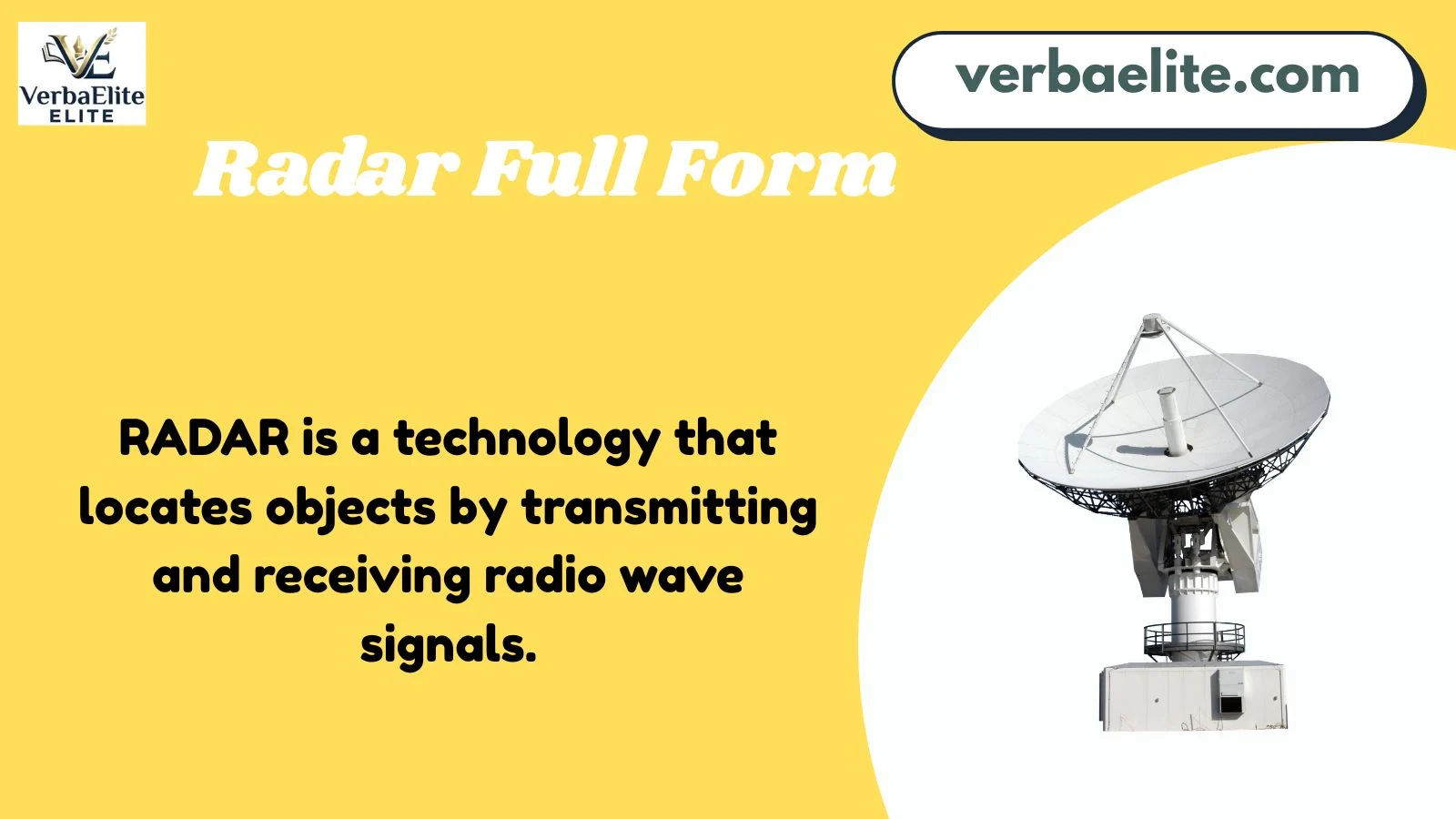
RADAR stands for Radio Detection and Ranging. It is an electronic system that uses radio waves to detect, locate, track, and measure the distance, speed, and direction of objects such as aircraft, ships, vehicles, and weather systems.
RADAR (Radio Detection and Ranging) is a technology that transmits radio waves and analyzes the reflected signals to identify the location, distance, speed, and movement of objects. It plays a critical role in aviation, defense, weather monitoring, marine navigation, traffic management, and automotive safety systems, making it one of the most widely used detection technologies in the modern world.
What Is the Full Form of RADAR?
The full form of RADAR is:
R – Radio
D – Detection
A – And
R – Ranging
Although many people write “Radar” as a normal word, it originally began as an acronym. Over time, it became so widely used that it is now commonly written in lowercase or title case in everyday communication.
Breakdown of the RADAR Full Form
| Letter | Word | Meaning |
|---|---|---|
| R | Radio | Uses radio waves instead of light or sound. |
| D | Detection | Finds the presence of an object. |
| A | And | Connects the two main functions. |
| R | Ranging | Measures the object’s distance and position. |
Together, Radio Detection and Ranging describes a system that detects objects and calculates how far away they are by using reflected radio waves.
What Is RADAR?
RADAR is an electronic detection system designed to locate and monitor objects that may be too far away, hidden by darkness, or obscured by fog, clouds, or rain. It works by transmitting radio waves toward a target and receiving the signals that bounce back.
By analyzing the returning waves, a radar system can determine:
- The distance to an object
- Its direction
- Its speed
- Its movement
- Its approximate size and shape
- Whether it is approaching or moving away
Unlike cameras, which require visible light, RADAR performs effectively in poor weather and at night, making it indispensable in safety-critical industries.
Meaning of RADAR in Simple Words
In simple terms, RADAR is a technology that helps people see objects they cannot see with their eyes.
Imagine shouting in a large cave. The sound echoes back after hitting a wall. By listening to the echo, you can estimate how far away the wall is.
RADAR works in a similar way, except it sends out radio waves instead of sound waves. When those waves strike an object, they reflect back to the radar antenna. The system measures how long the signal takes to return and uses that information to calculate the object’s location and movement.
This simple principle allows RADAR to detect aircraft, ships, storms, mountains, vehicles, drones, and even rainfall with remarkable accuracy.
History of RADAR
The development of RADAR was one of the most significant technological achievements of the twentieth century. Although scientists experimented with radio waves in the early 1900s, practical radar systems became especially important during World War II.
Early Research
Researchers discovered that radio waves could reflect from solid objects, opening the possibility of detecting targets from long distances.
Development During World War II
During the 1930s and 1940s, several countries accelerated radar research to improve national defense. Military forces used RADAR to detect incoming aircraft and naval vessels before they became visible, providing a major strategic advantage.
Post-War Expansion
After the war, radar technology expanded into civilian industries, including:
- Air traffic control
- Weather forecasting
- Marine navigation
- Scientific research
- Space exploration
- Law enforcement
Modern RADAR
Today’s radar systems are smaller, faster, and more accurate than ever before. They use advanced digital signal processing, artificial intelligence, and high-frequency electronics to improve detection accuracy and reduce interference.
Modern RADAR is now found in:
- Commercial aircraft
- Self-driving vehicles
- Weather satellites
- Military defense systems
- Airport control towers
- Smart traffic monitoring
- Maritime navigation systems
How Does RADAR Work?
RADAR works through a straightforward yet highly effective process that combines radio transmission, signal reflection, and computer analysis.
Step 1: Transmitting Radio Waves
A radar transmitter generates high-frequency radio waves and sends them through an antenna toward a target area.
Step 2: Reflection from an Object
When these radio waves strike an object—such as an airplane, ship, vehicle, mountain, or rain cloud—they bounce back toward the radar system.
Step 3: Receiving the Echo
The radar antenna receives the reflected radio waves, often called echoes.
Step 4: Signal Processing
A computer analyzes the returning signal to determine important information, including:
- Distance
- Direction
- Speed
- Altitude (in many systems)
- Movement pattern
Step 5: Displaying the Results
The processed information appears on a display screen, allowing operators to monitor the object’s location and movement in real time.
Simple Working Flow
Radio Signal → Object → Reflected Signal → Radar Receiver → Computer Processing → Object Location Displayed
Why Is RADAR So Important?
RADAR has transformed transportation, defense, weather science, and public safety because it can detect objects in situations where human vision is limited.
Its importance includes:
- Improves aviation safety
- Prevents collisions at sea
- Tracks severe weather systems
- Supports national defense
- Assists emergency rescue operations
- Enhances vehicle safety features
- Monitors traffic efficiently
- Supports scientific and space research
Its ability to operate in darkness, rain, fog, snow, and other challenging conditions makes it one of the most reliable detection technologies available today.
Components of a RADAR System
A RADAR system consists of several key components that work together to detect, locate, and track objects accurately. Each part plays a specific role in transmitting, receiving, and processing radio signals.
1. Transmitter
The transmitter generates high-frequency radio waves and sends them toward the target. It produces powerful electromagnetic pulses that travel through the air at the speed of light.
Function:
- Produces radio frequency (RF) signals
- Sends electromagnetic pulses
- Provides the power needed for long-distance detection
2. Antenna
The antenna transmits radio waves and receives the reflected signals (echoes). Many radar antennas rotate continuously to scan a wide area.
Function:
- Sends radio waves into the surrounding environment
- Receives reflected echoes
- Determines the direction of detected objects
3. Receiver
The receiver captures the weak signals reflected from the target and amplifies them for further processing.
Function:
- Detects returning radio waves
- Amplifies weak echoes
- Filters unwanted noise and interference
4. Signal Processor
The signal processor analyzes the received data to calculate important information about the detected object.
It determines:
- Distance
- Speed
- Direction
- Angle
- Altitude (in many radar systems)
- Movement pattern
Modern radar systems use advanced digital signal processors (DSPs) and artificial intelligence to improve accuracy.
5. Display Unit
The display unit presents processed information in an easy-to-understand format for operators.
Depending on the application, the display may show:
- Aircraft positions
- Ship locations
- Weather patterns
- Vehicle movement
- Storm tracking
- Terrain mapping
6. Power Supply
Every radar system requires a stable power source to operate the transmitter, receiver, antenna, and processing equipment.
Reliable power ensures continuous operation, especially in airports, military bases, ships, and weather stations.
Components of RADAR at a Glance
| Component | Primary Function |
|---|---|
| Transmitter | Generates radio waves |
| Antenna | Sends and receives signals |
| Receiver | Collects reflected signals |
| Signal Processor | Calculates position, speed, and distance |
| Display Unit | Shows radar information |
| Power Supply | Powers the complete system |
Types of RADAR
Different radar systems are designed for different purposes. Choosing the right type depends on the environment and the object being detected.
1. Pulse RADAR
Pulse radar transmits short bursts of radio waves and waits for the echoes before sending the next pulse.
Features
- Long-range detection
- High accuracy
- Widely used in aviation and military operations
Common Applications
- Air traffic control
- Airport surveillance
- Defense systems
2. Continuous Wave (CW) RADAR
Continuous Wave Radar continuously transmits radio waves instead of sending pulses.
Features
- Excellent speed measurement
- Simpler design
- Limited distance measurement
Common Applications
- Police speed guns
- Traffic monitoring
- Industrial speed measurement
3. Doppler RADAR
Doppler Radar measures changes in frequency caused by moving objects.
Features
- Measures speed accurately
- Tracks movement
- Detects approaching and receding objects
Common Applications
- Weather forecasting
- Storm tracking
- Wind analysis
- Aviation safety
4. Weather RADAR
Weather radar detects rain, snow, hail, and storms by analyzing reflected radio waves from precipitation.
Features
- Tracks severe weather
- Predicts rainfall
- Monitors hurricanes and thunderstorms
Common Applications
- Meteorology
- Climate research
- Disaster management
5. Marine RADAR
Marine radar helps ships safely navigate through oceans, rivers, and ports.
Features
- Detects nearby vessels
- Identifies coastlines
- Prevents collisions
Common Applications
- Cargo ships
- Fishing boats
- Naval vessels
- Passenger ships
6. Airborne RADAR
Installed on aircraft, airborne radar assists pilots in navigation and obstacle detection.
Features
- Detects other aircraft
- Avoids storms
- Supports landing operations
Common Applications
- Commercial airlines
- Fighter jets
- Rescue aircraft
7. Ground Penetrating RADAR (GPR)
Ground Penetrating Radar uses radio waves to examine objects below the Earth’s surface.
Features
- Non-destructive testing
- Underground mapping
- High-resolution imaging
Common Applications
- Archaeology
- Road inspection
- Utility detection
- Geological surveys
Types of RADAR Comparison
| Type | Main Purpose | Common Uses |
|---|---|---|
| Pulse RADAR | Long-range detection | Aviation, military |
| CW RADAR | Speed measurement | Traffic enforcement |
| Doppler RADAR | Motion tracking | Weather forecasting |
| Weather RADAR | Rain and storm detection | Meteorology |
| Marine RADAR | Navigation | Ships and ports |
| Airborne RADAR | Aircraft safety | Aviation |
| Ground Penetrating RADAR | Underground scanning | Construction and archaeology |
Applications of RADAR
RADAR technology has become an essential part of modern life. Its ability to detect objects in poor visibility makes it valuable across many industries.
1. Aviation
Airports use radar to:
- Track aircraft
- Guide takeoffs and landings
- Prevent collisions
- Monitor air traffic
- Improve flight safety
2. Military and Defense
Defense organizations rely on radar for:
- Missile detection
- Enemy aircraft tracking
- Border surveillance
- Target identification
- National security operations
3. Weather Forecasting
Meteorologists use radar to monitor:
- Rainfall intensity
- Thunderstorms
- Tornadoes
- Hurricanes
- Snowfall
- Wind movement
This helps issue timely weather warnings and reduce the impact of natural disasters.
4. Marine Navigation
Ships depend on radar to:
- Detect nearby vessels
- Navigate through fog
- Avoid underwater hazards
- Enter ports safely
- Operate during nighttime
5. Automotive Industry
Modern vehicles use radar for advanced driver assistance systems (ADAS), including:
- Adaptive cruise control
- Automatic emergency braking
- Blind-spot monitoring
- Collision avoidance
- Lane assistance
- Parking assistance
6. Space Exploration
Space agencies use radar to:
- Track satellites
- Monitor spacecraft
- Map planetary surfaces
- Detect space debris
- Support deep-space missions
7. Law Enforcement
Traffic police use radar guns to:
- Measure vehicle speed
- Enforce speed limits
- Improve road safety
- Reduce traffic accidents
8. Scientific Research
Researchers use radar for:
- Environmental monitoring
- Glacier movement studies
- Ocean wave analysis
- Geological exploration
- Climate research
Advantages of RADAR
RADAR offers several benefits that make it one of the most reliable detection technologies available.
Key Advantages
- Works day and night
- Operates effectively in rain, fog, and snow
- Detects objects over long distances
- Measures speed accurately
- Tracks multiple objects simultaneously
- Improves public safety
- Supports real-time monitoring
- Highly reliable in challenging environments
- Widely used across multiple industries
- Requires minimal visible light
Disadvantages of RADAR
Despite its many strengths, radar also has some limitations.
Common Disadvantages
- High installation and maintenance costs
- Performance may be affected by electronic interference
- Limited ability to identify object details compared to cameras
- Requires skilled operators in complex systems
- Large radar installations consume significant power
- Certain terrain and weather conditions can reduce detection accuracy
Industries That Use RADAR
| Industry | How RADAR Is Used |
|---|---|
| Aviation | Air traffic control and aircraft navigation |
| Defense | Surveillance, missile detection, and target tracking |
| Meteorology | Storm monitoring and weather prediction |
| Marine | Ship navigation and collision avoidance |
| Automotive | Driver assistance and collision prevention |
| Law Enforcement | Vehicle speed detection |
| Construction | Underground utility and structure detection |
| Mining | Geological surveys and mapping |
| Space Research | Satellite tracking and planetary exploration |
| Environmental Science | Climate, ocean, and glacier monitoring |
RADAR vs SONAR vs LiDAR
Understanding the difference between these technologies helps clarify where each one is most effective.
| Feature | RADAR | SONAR | LiDAR |
|---|---|---|---|
| Full Form | Radio Detection and Ranging | Sound Navigation and Ranging | Light Detection and Ranging |
| Uses | Radio waves | Sound waves | Laser light |
| Best Environment | Air and space | Underwater | Land and autonomous vehicles |
| Common Applications | Aviation, defense, weather | Submarines, marine exploration | Self-driving cars, mapping |
| Works in Darkness | Yes | Yes | Yes |
| Performance in Fog/Rain | Generally good | Not applicable (underwater) | Can be reduced in heavy fog or rain |
RADAR in Aviation
RADAR is one of the most important technologies in the aviation industry. It helps air traffic controllers and pilots monitor aircraft positions, maintain safe distances, and manage busy airspace efficiently. Without radar, modern air travel would be far more challenging and less safe.
How Aviation Uses RADAR
- Tracks aircraft during takeoff and landing
- Monitors aircraft positions in real time
- Prevents mid-air collisions
- Guides pilots during poor visibility
- Supports air traffic management
- Detects weather hazards near flight paths
Benefits in Aviation
- Improves passenger safety
- Reduces delays
- Enables safe flights in fog and rain
- Increases airport efficiency
RADAR in Military and Defense
Military organizations worldwide rely on RADAR for surveillance, early warning, and national security. It helps detect potential threats long before they reach protected areas.
Military Applications
- Aircraft detection
- Missile tracking
- Border surveillance
- Naval defense
- Battlefield monitoring
- Drone detection
- Target tracking
Modern military radar systems can monitor hundreds of targets simultaneously, making them a crucial part of defense operations.
RADAR in Weather Forecasting
Meteorologists use weather radar to observe atmospheric conditions and predict severe weather events. By analyzing reflected radio waves from rain, snow, and hail, weather radar provides accurate and timely information.
Weather Monitoring Uses
- Rainfall measurement
- Thunderstorm tracking
- Tornado detection
- Hurricane monitoring
- Snowfall estimation
- Wind movement analysis
Why It Matters
Weather radar allows governments and emergency services to issue warnings before dangerous weather arrives, helping protect lives and property.
RADAR in Marine Navigation
Ships often travel through fog, heavy rain, and darkness, where visibility is limited. Marine radar helps captains navigate safely by detecting nearby vessels, coastlines, and obstacles.
Marine Applications
- Collision avoidance
- Harbor navigation
- Coastal monitoring
- Ship tracking
- Search and rescue operations
- Safe navigation in poor weather
Marine radar is essential for commercial shipping, fishing fleets, naval vessels, and passenger ships.
RADAR in Automotive Safety
Modern vehicles increasingly use radar technology to improve driver safety through Advanced Driver Assistance Systems (ADAS).
Automotive Features Powered by RADAR
- Adaptive cruise control
- Automatic emergency braking
- Blind-spot monitoring
- Rear cross-traffic alert
- Lane change assistance
- Parking assistance
- Collision warning systems
These systems continuously monitor the surrounding environment and help reduce the risk of accidents.
Everyday Examples of RADAR
You may encounter radar technology more often than you realize.
Common Real-Life Examples
- Airplanes tracked by airport control towers
- Weather apps showing approaching storms
- Police speed detection devices
- Ships navigating through fog
- Cars with adaptive cruise control
- Satellite monitoring systems
- Military surveillance operations
These examples highlight how radar supports transportation, safety, communication, and scientific research every day.
FAQs:
What is the full form of RADAR?
The full form of RADAR is Radio Detection and Ranging. It is a technology that uses radio waves to detect, locate, and measure the distance, speed, and direction of objects such as aircraft, ships, vehicles, and weather systems.
What is RADAR used for?
RADAR is used in aviation, military defense, weather forecasting, marine navigation, automotive safety, traffic monitoring, scientific research, and space exploration. Its primary purpose is to detect and track objects accurately, even in darkness or poor weather conditions.
How does RADAR work?
RADAR works by transmitting radio waves toward an object. These waves bounce back after hitting the object, creating an echo. The radar system analyzes the reflected signal to determine the object’s distance, direction, speed, and movement.
Who invented RADAR?
RADAR technology evolved through contributions from many scientists during the early twentieth century. Significant advancements were made during the 1930s and World War II, leading to the modern radar systems used today.
Why are radio waves used in RADAR?
Radio waves can travel long distances and pass through darkness, fog, clouds, and rain better than visible light. This makes them ideal for detecting objects in conditions where cameras or the human eye may struggle.
What is the difference between RADAR and SONAR?
RADAR uses radio waves to detect objects in the air or on land, while SONAR uses sound waves underwater. RADAR is commonly used in aviation and weather monitoring, whereas SONAR is mainly used by submarines and ships for underwater navigation and exploration.
What are the advantages of RADAR?
Some major advantages of radar include long-range detection, operation in poor weather, accurate speed measurement, real-time tracking, and improved safety in aviation, transportation, and defense. It also works effectively during both day and night.
What are the limitations of RADAR?
Although radar is highly reliable, it has some limitations. Installation and maintenance can be expensive, electronic interference may affect performance, and radar generally provides less visual detail than cameras. Some advanced systems also require skilled operators.
Where is RADAR commonly used?
Radar is commonly used at airports, military bases, weather stations, ships, highways, research centers, satellites, and modern vehicles. Its versatility makes it one of the most widely used detection technologies across multiple industries.
Why is learning the RADAR full form important?
Understanding the RADAR full form helps students, competitive exam candidates, and technology enthusiasts learn the basics of one of the world’s most important electronic detection systems. It also provides a strong foundation for studying physics, electronics, aviation, and engineering.
Conclusion:
RADAR, which stands for Radio Detection and Ranging, is one of the most significant technological innovations of the modern era.
By using radio waves to detect, locate, and track objects, radar has transformed aviation, defense, weather forecasting, marine navigation, automotive safety, and scientific research.
Its ability to operate accurately in darkness and adverse weather conditions makes it indispensable for ensuring safety and efficiency across countless industries.
Whether you’re a student preparing for exams, a technology enthusiast, or simply curious about how the world around you works, understanding the RADAR full form, its working principle, types, and real-world applications provides valuable insight into a technology that impacts everyday life.
As radar systems continue to evolve with digital processing and artificial intelligence, they will remain a cornerstone of innovation, helping create safer transportation, smarter infrastructure, and more accurate environmental monitoring for years to come.

I am Naqash Ayub, the content creator behind VerbaElite, where I simplify full forms, abbreviations, and their meanings into easy to understand explanations. My goal is to provide accurate, reader friendly, and well researched content that helps students, professionals, and everyday readers quickly find the information they need.