
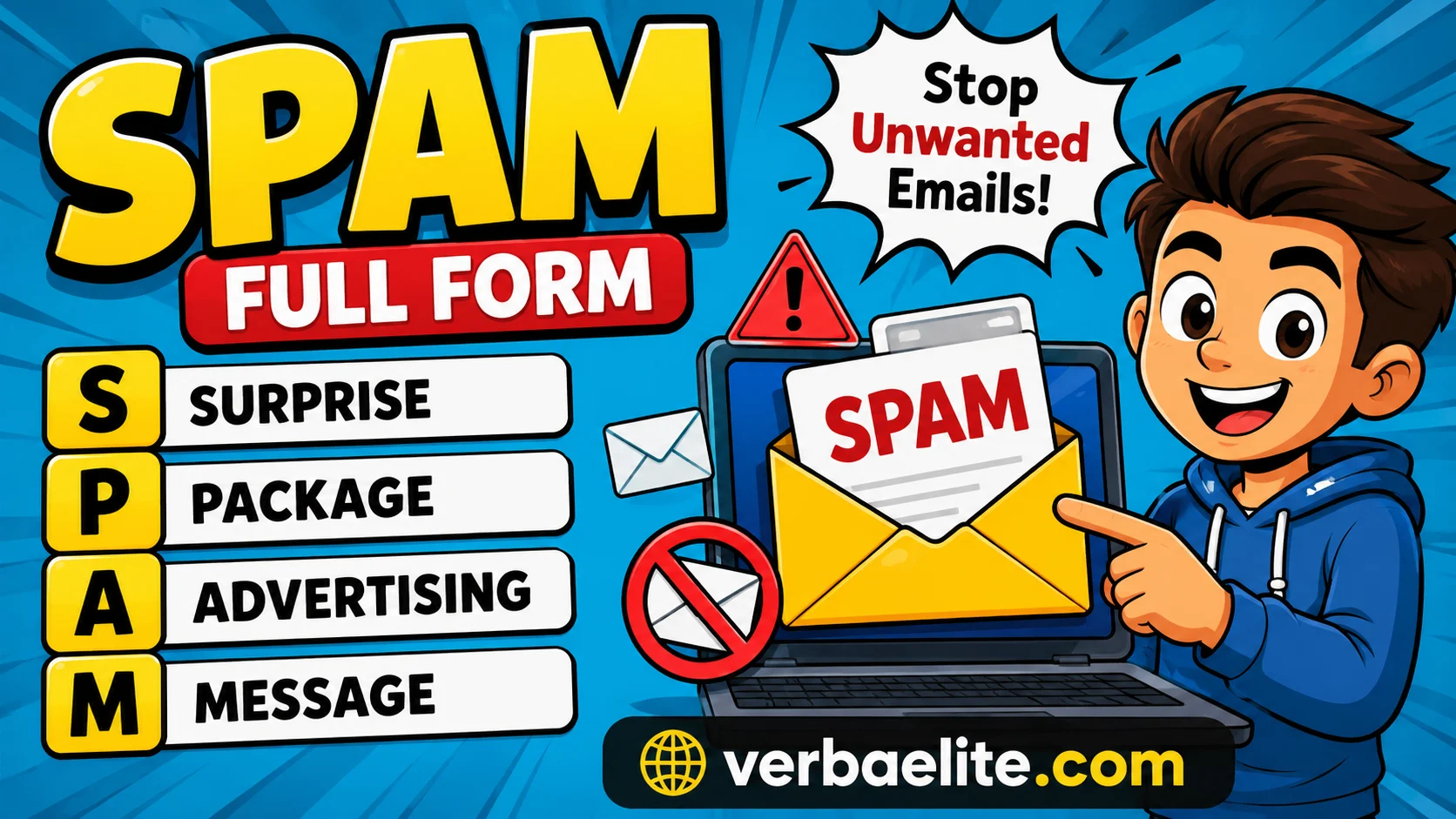
Spam is a familiar word, especially when unwanted emails, messages, or calls keep appearing at the worst possible time.
But what is the spam full form, and does the word actually stand for something? The answer is more interesting than many people expect.
While “spam” is widely used to describe unwanted or irrelevant digital content, its origin and meaning depend on the context in which it is used.
This article clears up the confusion in simple terms. You will learn whether SPAM has an official full form, what spam means in email and messaging, how the term became associated with unwanted communication, and the difference between spam, junk mail, and other unsolicited content.
You will also understand why the word is so common in internet safety and digital communication.
Whether you need the answer for general knowledge, an exam, or everyday online use, the following sections explain everything clearly, starting with the actual meaning and full form of spam.
SPAM has no official full form. It means unwanted or unsolicited messages, usually sent in bulk through email, text messages, calls, or online platforms.
Spam refers to unsolicited, unwanted, or irrelevant communication distributed to many recipients, usually through digital platforms. It commonly includes bulk emails, messages, calls, comments, and other content that recipients did not request.
What Is the Full Form of SPAM?
SPAM does not have an official full form. In modern usage, spam refers to unwanted, irrelevant, or unsolicited messages, especially emails, texts, calls, or online content sent in large quantities.
The word spam is commonly associated with unwanted bulk messages rather than being an acronym. However, some people incorrectly search for a full form such as “Sending and Posting Advertisement Messages.” This is not an officially recognized expansion of SPAM.
SPAM Meaning and Deep Explanation
In simple words, spam is unwanted communication. It usually reaches people without being requested and is often sent to many users at the same time.
For example, imagine opening your email inbox and finding dozens of messages promoting unknown products, fake prizes, suspicious offers, or unnecessary advertisements. Those unwanted messages are generally called spam emails.
Spam is not limited to email. Today, it can appear in many forms, including:
- Spam emails
- Spam text messages
- Spam phone calls
- Spam comments
- Spam social media messages
- Spam advertisements
- Spam links
- Automated bot messages
The main purpose of spam may be advertising, increasing website traffic, collecting personal information, spreading scams, or simply sending promotional content to a large number of people.
Why Is It Called Spam?
The modern use of the word spam for unwanted messages became popular through a famous comedy sketch by Monty Python. In the sketch, the word “Spam” is repeatedly mentioned until it overwhelms the conversation.
This idea later became connected with the internet because unwanted messages can also become repetitive and overwhelming. As a result, the term spam started being used for excessive, unwanted digital communication.
Interestingly, SPAM can also refer to a well-known canned meat product. Therefore, the meaning of the word depends on the context.
Example:
- I received 20 spam emails today.
Here, spam means unwanted emails. - He bought SPAM from the grocery store.
Here, SPAM refers to the canned food product.
This difference is important because people searching for the SPAM full form may encounter both meanings.
Is SPAM an Acronym?
No, SPAM is not officially an acronym for a longer phrase in the context of unwanted messages.
Many websites and online sources share supposed expansions of SPAM. One commonly mentioned phrase is:
Sending and Posting Advertisement Messages
However, this is not an official or universally accepted full form.
When discussing unwanted emails and messages, it is more accurate to say:
Spam has no official full form. It is a term used for unsolicited and unwanted bulk communication.
This distinction helps students, writers, and general users avoid sharing incorrect information.
Types of Spam
Spam can appear in several forms. Understanding these types makes the term easier to recognize and use correctly.
1. Email Spam
Email spam is one of the most common forms of spam. It includes unwanted emails sent to many recipients.
These messages may contain:
- Advertisements
- Fake offers
- Lottery claims
- Suspicious links
- Promotional messages
- Scam attempts
- Requests for personal information
Example:
You have won a prize! Click here immediately to claim it.
If you never entered such a competition and the message looks suspicious, it may be spam.
2. SMS Spam
SMS spam refers to unwanted text messages sent to mobile phones.
These messages often promote products, services, loans, prizes, or special offers. Some may also attempt to trick users into clicking dangerous links.
Example:
Congratulations! You have been selected for a special reward. Click the link now.
Always be careful with unexpected messages that create urgency or request personal information.
3. Phone Call Spam
Spam can also come through unwanted or automated phone calls.
These calls may involve:
- Robocalls
- Fake customer support
- Unwanted sales calls
- Scam calls
- Recorded promotional messages
Example:
A person receives repeated calls offering services they never requested. These can be described as spam calls.
4. Social Media Spam
Social media spam includes unwanted comments, messages, posts, or automated activity on platforms.
Common examples include:
- Repetitive promotional comments
- Fake accounts sending messages
- Unwanted links
- Bot-generated replies
- Repeated advertisements
Example:
A post receives dozens of identical comments saying, “Visit this website and earn money fast!”
This type of repetitive content is often considered spam.
5. Comment Spam
Comment spam usually appears on websites, blogs, forums, and videos.
Spammers may post irrelevant comments simply to advertise a website or create backlinks.
Example:
Great article! Visit our website to become rich quickly.
If the comment has little connection to the original content and mainly promotes another website, it may be comment spam.
6. Search Spam
Search spam refers to attempts to manipulate search engines through low-quality or deceptive content.
This may include:
- Repetitive keyword use
- Automatically generated pages
- Irrelevant content
- Misleading pages
- Manipulative links
Search engines generally try to identify low-quality spam and prevent it from appearing prominently in search results.
Spam Full Form in Email
- Unwanted messages sent in bulk to many email addresses
- Often used for advertising, scams, or misleading promotions
- May contain suspicious links or harmful attachments
- Can clutter your inbox and hide important emails
- Email providers automatically filter many spam messages
- Common examples include fake offers and lottery messages
- Never click unknown links in suspicious emails
- Avoid sharing personal information through spam emails
- Mark suspicious messages as spam to improve filtering
- Spam emails may use fake sender names to appear trustworthy
- Some spam messages try to steal passwords or banking details
- Phishing emails are a dangerous type of email spam
- Spam filters help protect users from unwanted messages
- Always verify the sender before opening unexpected emails
Spam Full Form in Text
- Spam in text messages means unwanted or unsolicited messages
- It is often sent to many phone numbers at once
- Commonly includes promotions, fake offers, or scam links
- Some spam texts pretend to come from trusted companies
- Smishing is a scam that uses fraudulent text messages
- Never click a suspicious link received through an unknown text
- Avoid replying with personal or financial information
- Block suspicious numbers to prevent future messages
- Report spam texts through your mobile service provider
- Spam messages may falsely claim you have won a prize
- Delivery and banking scams are common forms of text spam
- Legitimate companies usually do not ask for sensitive details unexpectedly
- Phone spam filters can identify and block suspicious messages
- Delete harmful or suspicious texts after reporting them
Spam Full Form in Chat
- Spam in chat means repeated or unwanted messages
- It can include advertisements, links, emojis, or copied text
- Spammers may send the same message to multiple users
- Excessive messaging can disturb conversations and communities
- Fake promotions are commonly shared through chat spam
- Suspicious links may lead to unsafe or fraudulent websites
- Some chat spam attempts to collect personal information
- Repeated messages are often considered spam in group chats
- Chat platforms may automatically detect suspicious activity
- Users can block or report accounts that send spam
- Avoid interacting with unknown accounts sharing random links
- Community rules often prohibit promotional spam
- Moderators may remove spam messages from group discussions
- Spam protection helps keep online conversations safe and useful
SPAM Full Form in Different Contexts
The meaning of spam changes according to where and how it is used.
| Context | Meaning of Spam | Use Case | Example |
|---|---|---|---|
| Unwanted email | Inbox communication | This message went to my spam folder. | |
| SMS | Unwanted text message | Mobile communication | I keep receiving spam texts. |
| Phone | Unwanted or suspicious calls | Telecommunications | Ignore suspected spam calls. |
| Social media | Repetitive or unwanted content | Online platforms | The account is posting spam comments. |
| Website | Irrelevant promotional content | Blogs and forums | The admin removed the spam. |
| Food | Canned meat product | Food and grocery context | She bought SPAM for lunch. |
The surrounding words usually make the intended meaning clear.
Common Examples of Spam
Here are some simple examples of spam and how the term is used.
1. Spam Email
Sentence: My inbox was full of spam emails.
Meaning: The inbox contained unwanted messages.
Category: Email Spam
Explanation: The emails were likely unsolicited or irrelevant.
2. Spam Text
Sentence: I received a spam message offering a fake prize.
Meaning: An unwanted and suspicious text was received.
Category: SMS Spam
Explanation: Unexpected prize offers are often used to attract attention.
3. Spam Call
Sentence: She blocked the number after receiving repeated spam calls.
Meaning: She received unwanted phone calls.
Category: Phone Spam
Explanation: Repeated unsolicited calls may be marked as spam.
4. Spam Comment
Sentence: The website removed hundreds of spam comments.
Meaning: The site deleted irrelevant or promotional comments.
Category: Comment Spam
Explanation: These comments did not add useful discussion.
5. Social Media Spam
Sentence: The account was suspended for posting spam.
Meaning: The account repeatedly shared unwanted or inappropriate content.
Category: Social Media Spam
Explanation: Repetitive automated activity can violate platform rules.
6. Spam Folder
Sentence: Check your spam folder for the missing email.
Meaning: Check the folder where suspicious or unwanted emails are filtered.
Category: Email
Explanation: Legitimate emails can sometimes be filtered incorrectly.
7. Promotional Spam
Sentence: Users complained about receiving too much promotional spam.
Meaning: They received excessive unwanted advertisements.
Category: Advertising
Explanation: Frequent unsolicited promotions can become spam.
8. Link Spam
Sentence: Do not click links sent through suspicious spam messages.
Meaning: Avoid potentially unsafe links in unwanted messages.
Category: Online Security
Explanation: Some spam messages use links to mislead users.
9. Forum Spam
Sentence: Moderators deleted the spam from the discussion forum.
Meaning: Irrelevant or repetitive posts were removed.
Category: Community Content
Explanation: Spam reduces the quality of genuine discussions.
10. Bot Spam
Sentence: The company added protection against bot spam.
Meaning: It introduced measures against automated unwanted activity.
Category: Automation
Explanation: Bots can send large amounts of repetitive content quickly.
11. Advertisement Spam
Sentence: The app showed users too many spam advertisements.
Meaning: Users were repeatedly exposed to unwanted promotions.
Category: Advertising
Explanation: Excessive advertising may negatively affect user experience.
12. Unsolicited Spam
Sentence: Never share sensitive information in response to unsolicited spam.
Meaning: Do not respond carelessly to unexpected unwanted messages.
Category: Security
Explanation: Unsolicited communication may not always be trustworthy.
How Does Spam Work?
Spam generally works by sending one message to many people.
The sender may use automated systems to distribute large numbers of emails, texts, or comments quickly. Even if only a small percentage of recipients respond, the campaign may still benefit the sender.
A typical spam process may involve:
- Creating a promotional or misleading message.
- Sending it to a large number of recipients.
- Encouraging people to click, reply, buy, or share information.
- Repeating the process on a large scale.
Not every spam message is necessarily a scam. Some spam messages simply advertise products or services without permission. However, users should remain cautious because unwanted messages can sometimes contain misleading claims.
Why Do People Send Spam?
People send spam for different reasons.
Advertising
Some businesses or marketers send large numbers of promotional messages to attract potential customers.
Website Promotion
Spammers may post links repeatedly to increase visits to a website.
Scams
Some messages attempt to deceive recipients through fake prizes, urgent warnings, or false offers.
Data Collection
Suspicious messages may try to encourage people to provide personal or financial information.
Automated Traffic
Bots can create repetitive activity to promote pages, products, or services.
The key characteristic is usually the same: the communication is unwanted, excessive, irrelevant, or unsolicited.
How to Identify Spam
Recognizing spam can help you avoid unnecessary messages and suspicious communication.
Look for these warning signs:
- The message is unexpected.
- It promises an unrealistic reward.
- It creates unnecessary urgency.
- It contains suspicious links.
- It asks for sensitive information unexpectedly.
- It includes many spelling or grammar mistakes.
- The sender is unfamiliar.
- The same message is repeatedly sent.
- The content is irrelevant to you.
One warning sign alone does not always prove that a message is spam. However, multiple warning signs should encourage caution.
How to Avoid Spam
You cannot always prevent spam completely, but you can reduce your exposure.
Use Spam Filters
Email services often provide filters that automatically move suspicious messages away from your main inbox.
Avoid Sharing Contact Information Publicly
Posting your email address or phone number everywhere online may increase unwanted contact.
Do Not Respond to Suspicious Messages
Responding can sometimes confirm that an account or number is active.
Be Careful With Links
Avoid clicking unexpected links, particularly when a message pressures you to act immediately.
Report Spam
Many platforms allow users to mark unwanted emails, calls, or messages as spam.
Block Repeated Senders
Blocking unwanted numbers or accounts can reduce repeated communication.
Spam Full Form in Instagram
- Spam on Instagram means unwanted or repetitive activity
- It may include repeated comments on multiple posts
- Unwanted promotional messages can be considered spam
- Fake accounts often send suspicious direct messages
- Spam comments may contain unrelated links or promotions
- Excessive liking or following can also appear spammy
- Some accounts use bots to spread spam automatically
- Fake giveaways are a common form of Instagram spam
- Never share login details with suspicious accounts
- Avoid clicking unknown links sent through direct messages
- Users can report spam accounts and comments
- Blocking an account prevents further unwanted interaction
- Instagram may limit accounts showing suspicious behavior
- Spam detection helps create a safer social media experience
Spam Full Form on iPhone
- Spam on iPhone usually refers to unwanted calls, texts, or emails
- Spam calls may come from unknown or suspicious numbers
- Unwanted promotional messages can appear in the Messages app
- Suspicious emails may be filtered into the Junk folder
- Users can block unwanted phone numbers and contacts
- Unknown callers can be silenced using iPhone settings
- Suspicious messages should not be opened carelessly
- Never share verification codes with unknown callers
- Spam callers may pretend to represent banks or companies
- Scam texts may contain dangerous or misleading links
- Blocking and reporting can reduce future spam
- Built-in filtering features can help manage unwanted messages
- Keeping the device updated improves security protection
- Always verify unexpected messages before responding
Spam Full Form Food
- SPAM is a brand name for a popular canned meat product
- The product was introduced by Hormel Foods in 1937
- It is made primarily from pork and ham
- The name SPAM is not officially treated as an acronym
- SPAM became widely popular during World War II
- Its long shelf life made it useful for military food supplies
- It is now sold and recognized in many countries
- SPAM can be fried, grilled, baked, or added to recipes
- It is especially popular in several Asian and Pacific cuisines
- Different varieties of SPAM are available today
- The product has become an important part of food culture
- SPAM food and digital spam have completely different meanings
- The similarity in names often creates confusion
- Context helps determine whether SPAM means food or unwanted messages
Spam Meaning in Social Media
- Spam means unwanted, repetitive, or irrelevant online content
- It can appear in comments, posts, messages, and replies
- Repeated promotional content is commonly considered spam
- Fake accounts may be created to distribute spam
- Automated bots can spread large amounts of unwanted content
- Spam may contain links to misleading websites
- Some spam posts promote scams or fake products
- Excessive tagging of unrelated users can be spammy
- Repeating the same comment on many posts is considered spam
- Social media platforms allow users to report spam
- Blocking suspicious accounts can stop unwanted interaction
- Algorithms may automatically detect unusual spam behavior
- Spamming can reduce the credibility of an account
- Good social media behavior focuses on relevant and genuine engagement
SPAM vs Scam: What Is the Difference?
Spam and scams are related but they are not exactly the same.
Spam is unwanted or unsolicited communication. It may simply advertise a product.
A scam is designed to deceive someone for money, information, or another benefit.
Simple difference:
- Spam: Unwanted message
- Scam: Deceptive attempt to trick someone
Some spam messages are harmless advertisements, while others may contain scams. Therefore, not all spam is a scam, but a scam can be delivered through spam.
SPAM vs Junk Mail
Spam and junk mail are often used in similar ways, especially in email.
Spam usually emphasizes unsolicited or unwanted bulk messages.
Junk mail can refer more generally to unwanted or low-priority messages.
Many email services use folders with names such as Spam or Junk to separate suspicious messages from the main inbox.
In everyday usage, people often use the terms interchangeably.
SPAM vs Phishing
Spam and phishing are also different.
Spam is unwanted communication sent without the recipient’s request.
Phishing is a specific type of deceptive attack that tries to trick people into revealing sensitive information or taking unsafe actions.
For example:
- An unwanted store advertisement may be spam.
- A fake bank message asking for login details may be phishing.
Therefore, phishing is more specific and potentially more dangerous than ordinary spam.
How to Use the Word “Spam” in Writing
Use the word spam when describing unwanted, unsolicited, repetitive, or irrelevant communication.
Correct Usage
- My email provider blocked the spam.
- Please report suspicious spam messages.
- The website has a filter for comment spam.
- I received several spam calls today.
The word can function as a noun.
Example:
This is spam.
It can also be used informally as a verb.
Example:
Do not spam the group chat.
In this sentence, spam means repeatedly sending excessive or unwanted messages.
Writing Guide: Using Spam Naturally
When writing about spam, first make the context clear.
Instead of repeatedly saying spam, use related phrases where appropriate:
- Unwanted messages
- Unsolicited emails
- Bulk communication
- Suspicious messages
- Repetitive content
- Junk messages
- Unwanted promotions
This improves readability and prevents unnecessary repetition.
Use the Correct Context
“Spam” can mean different things depending on the subject.
If you are writing about email, explain that you mean unwanted digital messages. If you are discussing food, use the appropriate context for the SPAM product.
Avoid Unnecessary Repetition
Do not force the phrase SPAM full form into every paragraph. Answer the question clearly, then naturally discuss meaning, examples, types, and usage.
Keep the Definition Simple
For students and general readers, the clearest definition is usually:
Spam means unwanted or unsolicited communication, often sent in bulk.
Common Mistakes About SPAM Full Form
1. Assuming SPAM Has an Official Expansion
One of the biggest mistakes is presenting an unofficial phrase as the confirmed full form.
The more accurate answer is that spam, in the context of unwanted messages, does not have an official full form.
2. Confusing Spam With Every Scam
Not every unwanted message is necessarily a scam. Spam describes unwanted communication, while scams specifically attempt to deceive.
3. Ignoring Context
Spam can refer to digital communication or a food product. The correct meaning depends on the sentence.
4. Calling Every Advertisement Spam
An advertisement is not automatically spam. If users requested or agreed to receive promotional content, it may be legitimate marketing rather than spam.
5. Clicking Every Message in the Spam Folder
Spam filters are helpful, but suspicious messages should still be treated carefully.
SPAM Usage Guide: Do and Don’t
Do
- Use spam for unwanted or unsolicited communication.
- Check the context before explaining its meaning.
- Explain that spam has no official full form.
- Use simple examples for students.
- Distinguish spam from scams and phishing.
- Report repeated unwanted communication when appropriate.
Don’t
- Present an unofficial expansion as an official fact.
- Assume every spam message is a scam.
- Share sensitive information through suspicious messages.
- Click unexpected links without checking them.
- Repeatedly use the keyword in an unnatural way.
- Ignore the difference between digital spam and the SPAM food product.
What Does SPAM Stand For?
- SPAM does not have one universal full form in every context
- In digital communication, spam usually means unwanted bulk messages
- The term can apply to emails, texts, calls, chats, and social media
- Digital spam is often associated with unsolicited advertising
- Some spam messages are harmless but annoying
- Others may involve scams, phishing, or fraudulent activity
- Spam messages are often sent to a large number of users
- The sender may use fake identities to hide their real identity
- Spam filters help identify and separate unwanted content
- Users should avoid clicking suspicious links or attachments
- The word spam can also refer to the famous canned meat product
- SPAM food is a brand name rather than a standard full form
- The meaning of SPAM depends on the context in which it is used
- Always consider whether SPAM refers to unwanted messages or the food brand
Natural Chat Responses Using “Spam”
Here are some natural ways to use the word in everyday conversation:
“Check your spam folder. The email might have gone there by mistake.”
“I keep getting spam calls from unknown numbers.”
“Don’t click that link. It looks like spam to me.”
“The group chat is full of spam today.”
“Please stop spamming the same message again and again.”
“I marked the email as spam because I never signed up for those messages.”
These examples show that the word can describe emails, calls, messages, links, and repeated online activity.
FAQs:
1. What is the full form of SPAM?
SPAM does not have an official full form in the context of unwanted emails and messages. The word refers to unsolicited, unwanted, or irrelevant communication, often sent in bulk. Some unofficial expansions appear online, but they should not be presented as the official meaning of SPAM.
2. What does spam mean?
Spam means unwanted or unsolicited communication. It commonly refers to emails, text messages, phone calls, comments, or online posts that a person did not request. Spam is often sent to many people at once and may contain advertisements, promotions, suspicious links, or repetitive content.
3. Is SPAM an acronym?
No, spam is not officially an acronym for a longer phrase when referring to unwanted digital communication. Although several supposed full forms are shared online, there is no universally recognized official expansion. The safest and most accurate explanation is that spam is a term for unwanted or unsolicited messages.
4. What is an example of spam?
An example of spam is receiving an unexpected email claiming that you have won a prize and asking you to click a link immediately. Other examples include repeated promotional text messages, unwanted automated calls, irrelevant comments, and fake social media messages sent without your permission.
5. What are the main types of spam?
Common types include email spam, SMS spam, phone call spam, social media spam, comment spam, link spam, and automated bot spam. Although their platforms differ, they generally share the same characteristic: the communication is unwanted, unsolicited, repetitive, or irrelevant to the recipient.
6. What is the difference between spam and a scam?
Spam is unwanted communication, while a scam is an attempt to deceive someone for money, information, or another benefit. Not all spam is a scam because some spam simply contains unwanted advertising. However, scams are often distributed through spam emails, messages, calls, and social media accounts.
7. What is the difference between spam and phishing?
Spam is a broad term for unwanted communication. Phishing is a specific deceptive technique used to trick people into revealing sensitive information or taking unsafe actions. A phishing email may also be spam, but ordinary spam does not necessarily try to steal passwords, financial information, or other personal data.
8. How can students use the word spam in a sentence?
Students can use spam when discussing unwanted digital communication. For example: “The email service moved suspicious messages to the spam folder.” Another example is: “Our teacher warned us not to click unknown links in spam emails.” These sentences clearly show how the word is used in everyday digital contexts.
9. Why is spam important in online communication?
Understanding spam is important because it helps people organize digital communication and recognize unwanted content. Spam filters reduce clutter in inboxes, while awareness helps users identify suspicious messages. Knowing the difference between ordinary spam, scams, and phishing can also support safer and more responsible internet use.
10. How can I avoid spam messages?
You can reduce spam by using spam filters, keeping contact information private when possible, avoiding suspicious links, reporting unwanted messages, and blocking repeated senders. Never assume every unexpected message is trustworthy. If a message requests sensitive information or creates unusual urgency, verify it independently before responding.
Conclusion
The answer to “SPAM full form” is simple but often misunderstood: SPAM has no official full form when referring to unwanted digital messages. Spam means unsolicited, irrelevant, or unwanted communication, usually sent in bulk through emails, texts, calls, comments, or other online platforms. Understanding its meaning helps users identify unwanted content and distinguish spam from scams and phishing. For students, writers, and everyday internet users, the key point is to focus on the context rather than memorizing an unofficial expansion. Knowing how spam works, recognizing its common forms, and using the term correctly can also improve digital awareness and online communication skills.

I am Naqash Ayub, the content creator behind VerbaElite, where I simplify full forms, abbreviations, and their meanings into easy to understand explanations. My goal is to provide accurate, reader friendly, and well researched content that helps students, professionals, and everyday readers quickly find the information they need.