

If you have searched for BCom full form, you probably want more than just the expansion.
The abbreviation is simple, but BCom can lead to several questions about subjects, eligibility, jobs, salary, and higher studies.
So, let’s make the meaning and everything connected to it easy to understand.
BCom stands for Bachelor of Commerce. It is an undergraduate degree focused on commerce, accounting, finance, business, economics, and related subjects.
BCom, or Bachelor of Commerce, is an undergraduate degree in commerce and business studies. It commonly covers accounting, finance, economics, taxation, business law, management, and related areas. BCom prepares students for careers in accounting, banking, finance, business, and administration while also providing a foundation for postgraduate and professional qualifications.
BCom Full Form
The full form of BCom is Bachelor of Commerce.
BCom is an undergraduate academic degree designed for students interested in commerce, accounting, finance, business, economics, taxation, banking, and management. It is commonly chosen after completing higher secondary education, particularly by students who have studied commerce or business-related subjects.
The abbreviation is written as B.Com, BCom, or Bachelor of Commerce. The exact course structure, eligibility requirements, and specialization options can vary between universities and countries.
BCom Full Form at a Glance
| Term | Details |
|---|---|
| Full Form | Bachelor of Commerce |
| Abbreviation | BCom / B.Com |
| Degree Level | Undergraduate |
| Main Area | Commerce and Business |
| Common Subjects | Accounting, Economics, Finance, Business Law |
| Typical Duration | 3–4 years, depending on the country and university |
| Common Career Areas | Banking, Accounting, Finance, Taxation, Business |
| Higher Studies | MCom, MBA, CA, ACCA, CFA and other professional programs |
What Is BCom?
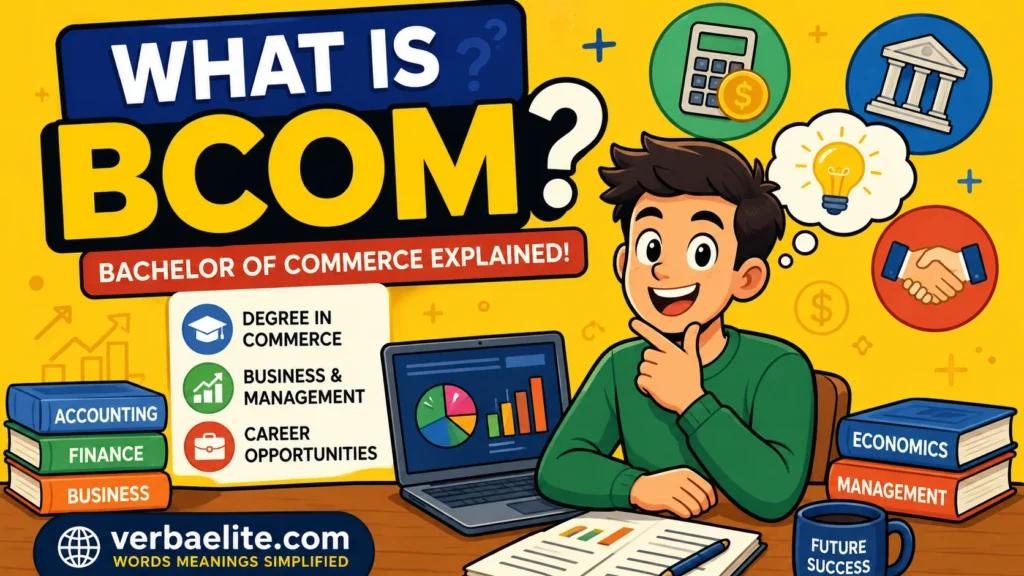
Bachelor of Commerce (BCom) is a bachelor’s degree that provides students with knowledge of commerce and business-related disciplines.
The degree generally combines theoretical concepts with practical understanding. Students may learn how businesses record transactions, manage money, analyze financial information, understand markets, follow business laws, and make commercial decisions.
BCom can be a useful foundation for both employment and further education. Some graduates enter banking, accounting, sales, administration, or finance-related roles, while others continue toward professional qualifications or postgraduate degrees.
What Does BCom Mean?
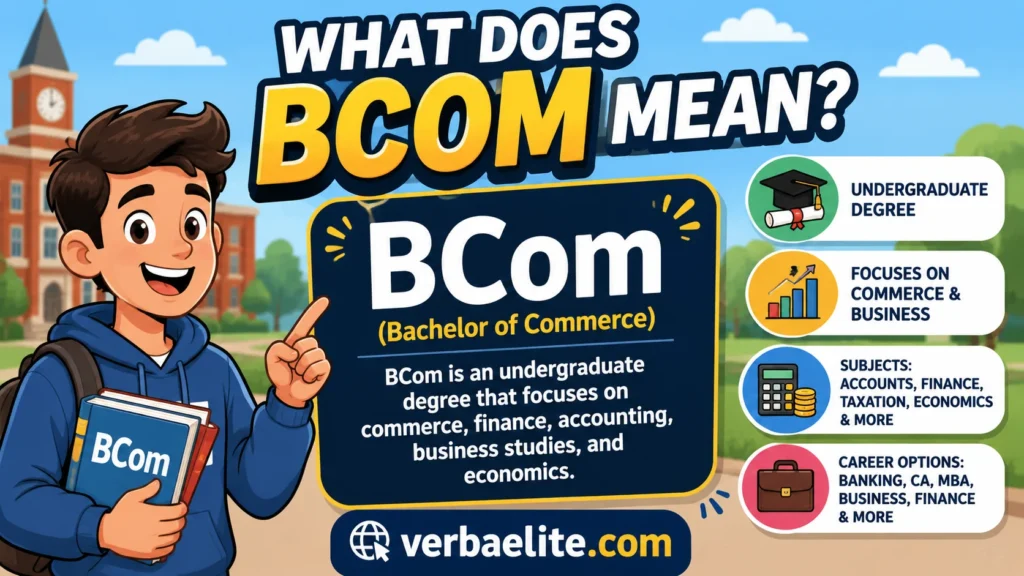
The term Bachelor of Commerce can be understood in three parts:
- Bachelor — an undergraduate university degree.
- Commerce — the study of business, trade, finance, accounting, and economic activities.
- BCom — the commonly used abbreviation for Bachelor of Commerce.
In simple words, BCom means a bachelor’s degree that focuses on commerce and business-related subjects.
BCom Subjects

The subjects depend on the university and specialization, but common BCom subjects include:
- Financial Accounting
- Cost Accounting
- Business Economics
- Business Mathematics
- Business Statistics
- Principles of Management
- Business Law
- Taxation
- Auditing
- Corporate Accounting
- Financial Management
- Marketing
- Human Resource Management
- Entrepreneurship
- Computer Applications in Business
- Banking and Finance
Some universities also offer specialized versions such as BCom Accounting and Finance, BCom Banking and Insurance, BCom International Business, or other commerce-focused programs.
BCom Course Duration

The duration of a BCom program depends on the education system and university.
In many institutions, a traditional BCom degree takes three years, while some universities and countries offer four-year undergraduate programs.
Students should always check the official university curriculum because the duration, credit requirements, internship structure, and specialization options can differ.
BCom Eligibility
BCom eligibility varies by institution, but students generally need to complete their higher secondary or equivalent education before applying.
Common requirements may include:
- Completion of Grade 12 or an equivalent qualification.
- Meeting the university’s minimum marks requirement.
- Meeting any required subject prerequisites.
- Completing an entrance examination if the institution requires one.
- Fulfilling the university’s admission requirements.
Commerce students often choose BCom because their previous studies may already include accounting, economics, business, or mathematics. However, eligibility for students from other academic backgrounds depends on the university.
BCom Specializations
BCom is not limited to one area of commerce. Depending on the institution, students may choose a specialization or concentration.
Popular areas include:
BCom Accounting
This focuses strongly on accounting principles, financial reporting, auditing, and related areas.
BCom Finance
Finance-oriented programs emphasize financial management, investment concepts, banking, and financial analysis.
BCom Banking
This pathway is designed for students interested in banking operations, financial services, and related commercial activities.
BCom Taxation
Tax-focused study introduces students to taxation principles, compliance, and tax-related accounting.
BCom Management
This combines commerce with management concepts such as organizational behavior, marketing, human resources, and business strategy.
BCom Scope
The scope of BCom is broad because commerce connects with many areas of the economy.
After graduation, students can explore opportunities in:
- Accounting
- Banking
- Finance
- Insurance
- Taxation
- Business administration
- Sales
- Marketing
- Human resources
- E-commerce
- Financial services
- Government organizations
- Entrepreneurship
However, a BCom degree by itself does not guarantee a particular job or salary. Career outcomes depend on factors such as skills, experience, location, specialization, professional qualifications, and the employer.
BCom Career Options
A BCom graduate can consider a variety of entry-level and business-related career paths.
Accountant
Accountants help organizations maintain financial records, prepare reports, and manage accounting information.
Financial Analyst
Financial analysts examine financial information and may support business or investment decisions.
Banking Professional
BCom graduates may pursue roles in banking and financial services, depending on employer requirements.
Tax Associate
Tax-related roles can involve preparing documentation, assisting with compliance, and working with taxation information.
Auditor
Auditing involves examining financial records and processes to assess their accuracy and compliance with applicable requirements.
Business Executive
Graduates may also work in administrative, sales, operations, or business-development positions.
Entrepreneur
Commerce knowledge can also help students understand business finances, costs, revenue, markets, and basic management.
BCom vs BBA
BCom and BBA are both undergraduate business-related degrees, but their emphasis can differ.
| Feature | BCom | BBA |
| Full Form | Bachelor of Commerce | Bachelor of Business Administration |
| Main Focus | Commerce, accounting, finance | Business and management |
| Common Subjects | Accounting, economics, taxation | Management, marketing, HR |
| Suitable For | Commerce and finance interests | Management and business interests |
| Common Higher Study | MCom, MBA, professional qualifications | MBA and related programs |
Neither degree is universally “better.” The right choice depends on your interests and career goals.
BCom vs MCom
BCom is an undergraduate degree, while MCom stands for Master of Commerce and is generally a postgraduate degree.
A student typically completes BCom before pursuing MCom, although admission rules depend on the institution.
In simple terms:
BCom = undergraduate commerce degree
MCom = postgraduate commerce degree
BCom vs CA
BCom and CA are not the same qualification.
BCom is a university-level undergraduate degree, whereas CA (Chartered Accountant) is a professional accounting qualification with its own examination, training, and regulatory requirements.
A student can pursue BCom and a professional accounting qualification as separate or complementary educational paths, depending on the applicable rules.
BCom After 12th
Students often choose BCom after completing their higher secondary education.
It can be particularly suitable for students who enjoy:
- Accounting
- Business
- Economics
- Finance
- Mathematics
- Taxation
- Banking
- Entrepreneurship
Before choosing a university, students should compare the curriculum, admission requirements, accreditation or recognition, fees, duration, internships, and career support.
Is BCom a Good Degree?
BCom can be a strong choice for students who want a foundation in commerce, accounting, finance, and business.
Its value is often increased when students develop practical skills alongside their academic studies. For example, learning Excel, accounting software, financial analysis, communication, data handling, and business writing can make a graduate more prepared for workplace responsibilities.
Students who want highly specialized careers may also consider professional qualifications or postgraduate education after BCom.
How to Make a BCom Degree More Valuable
A degree is only one part of career development. Students can strengthen their profile by:
- Building strong accounting fundamentals.
- Learning spreadsheet and data-analysis tools.
- Improving communication skills.
- Completing internships.
- Developing financial literacy.
- Understanding business technology.
- Participating in practical projects.
- Exploring professional certifications.
- Building a professional resume and portfolio.
- Developing problem-solving and analytical skills.
Common Mistakes About BCom
1. Thinking BCom Means Only Accounting
Accounting is an important part of BCom, but the degree can cover economics, finance, taxation, management, law, marketing, statistics, and other areas.
2. Assuming Every BCom Program Is Identical
Universities can have substantially different curricula, specializations, durations, and admission requirements.
3. Choosing the Degree Only for Its Name
Students should consider their interests and long-term career plans instead of choosing a program solely because it sounds popular.
4. Ignoring Practical Skills
Academic knowledge is important, but workplace skills can also influence employability.
5. Confusing BCom With CA
BCom is an academic bachelor’s degree; CA is a professional qualification. They can complement each other, but they are not interchangeable.
BCom Usage in a Sentence
Here are some natural examples:
- I am planning to pursue a BCom after completing my higher secondary education.
- She completed her BCom and started working in the banking sector.
- My brother is studying BCom with a focus on accounting.
- He chose BCom because he is interested in finance and business.
- After BCom, she plans to pursue a postgraduate degree.
Quick Context Table
| Context | Meaning | Use Case | Example |
| Education | Bachelor of Commerce | University degree | He is studying BCom. |
| Accounting | Commerce education | Accounting career foundation | BCom includes accounting subjects. |
| Finance | Business and financial studies | Finance-related careers | She chose BCom Finance. |
| Banking | Commerce and financial services | Banking career preparation | BCom can support banking studies. |
| Higher Education | Undergraduate qualification | Further study | He plans to pursue postgraduate study after BCom. |
Natural Chat Responses Using BCom
“What are you studying?”
“I’m doing BCom because I’m interested in accounting and finance.”
“What does BCom stand for?”
“It stands for Bachelor of Commerce.”
“What can I do after BCom?”
“You can explore accounting, banking, finance, taxation, business, or further studies.”
“Is BCom only about accounting?”
“No. It can include finance, economics, management, taxation, business law, and several other subjects.”
“Why did you choose BCom?”
“I wanted a degree that gives me a foundation in business and commerce.”
FAQs:
1. What is the full form of BCom?
BCom stands for Bachelor of Commerce. It is an undergraduate degree focused on commerce and business-related subjects. Depending on the university, students may study accounting, finance, economics, taxation, business law, management, statistics, and related disciplines. BCom can prepare students for entry-level business careers and provide a foundation for postgraduate education or professional qualifications.
2. What does BCom mean?
BCom means Bachelor of Commerce, a bachelor’s degree in commerce. The program generally introduces students to accounting, finance, economics, business, taxation, and other commercial subjects. It is commonly selected by students who want to develop knowledge relevant to business, accounting, banking, financial services, or entrepreneurship.
3. What are the main subjects in BCom?
Common BCom subjects include financial accounting, economics, business law, taxation, auditing, financial management, business mathematics, statistics, management, and marketing. The exact subjects depend on the university and specialization. Some programs may also include computer applications, entrepreneurship, banking, insurance, or international business.
4. Is BCom good for accounting?
Yes, BCom can provide a useful academic foundation for accounting because accounting is commonly an important part of the curriculum. Students interested in professional accounting careers may also consider additional professional qualifications after or alongside their degree, depending on the requirements of their intended career and jurisdiction.
5. What can students do after BCom?
After BCom, graduates can explore careers in accounting, banking, finance, taxation, auditing, administration, sales, business operations, and financial services. They can also pursue further education such as MCom, MBA, or relevant professional qualifications. The best path depends on a student’s interests, skills, career target, and local employment requirements.
6. Is BCom the same as BBA?
No. BCom means Bachelor of Commerce, while BBA means Bachelor of Business Administration. BCom generally has a stronger connection with commerce, accounting, finance, and economics, while BBA often places greater emphasis on management and business administration. However, there can be significant overlap between the two programs.
7. What is the difference between BCom and MCom?
BCom is generally an undergraduate bachelor’s degree, while MCom, or Master of Commerce, is generally a postgraduate degree. Students commonly pursue BCom first and then choose MCom or another advanced qualification. The specific admission pathway depends on the university and education system.
8. Can I do BCom after 12th?
Yes, students can generally apply for BCom after completing their higher secondary education or an equivalent qualification, provided they meet the university’s admission requirements. Eligibility can differ between institutions, including minimum marks, required subjects, entrance tests, and other conditions.
9. Is BCom only for commerce students?
Not necessarily. Whether students from other academic backgrounds can enter BCom depends on the university’s eligibility rules. Some institutions accept students from multiple backgrounds, while others may require particular subjects. Students should check the admission criteria of the specific university before applying.
10. What is the difference between BCom and CA?
BCom is an academic undergraduate degree, whereas CA, or Chartered Accountant, is a professional accounting qualification. BCom provides broad education in commerce and business, while CA training focuses more specifically on professional accounting, auditing, taxation, financial reporting, and related areas. They can be complementary educational paths.
Conclusion:
BCom stands for Bachelor of Commerce, an undergraduate degree centered on commerce and business-related studies.
It commonly introduces students to accounting, finance, economics, taxation, business law, management, and other commercial disciplines.
For students interested in accounting, banking, finance, business, or entrepreneurship, BCom can provide a broad academic foundation.
Its usefulness becomes even stronger when students combine classroom learning with practical skills, internships, technology knowledge, communication abilities, and relevant professional qualifications.

I am Naqash Ayub, the content creator behind VerbaElite, where I simplify full forms, abbreviations, and their meanings into easy to understand explanations. My goal is to provide accurate, reader friendly, and well researched content that helps students, professionals, and everyday readers quickly find the information they need.