

Ever received an email saying, “Please send the report by COB” and wondered what those three letters meant?
It sounds complicated, but the meaning is surprisingly simple.
COB is a common business abbreviation used to communicate a workday deadline.
COB stands for “Close of Business” in email. It usually means something should be completed or submitted before the end of the business working day.
What Does COB Mean in Email?

COB stands for Close of Business. In professional emails, it is commonly used when someone wants an action completed before the working day officially ends.
For example:
“Please send me the revised document by COB.”
This means the sender expects the revised document by the close of the business day.
COB is especially common in workplaces, corporate communication, banking, finance, customer service, project management, and professional correspondence.
The exact time represented by COB can vary between companies, industries, and countries. A business may consider its working day finished at 5:00 p.m., while another organization may use 6:00 p.m. Therefore, if the deadline is important and the working hours are unclear, it is better to confirm the exact time.
Simple Meaning of COB
| Term | Meaning |
|---|---|
| COB | Close of Business |
| COB meaning | End of the business working day |
| Common use | Professional emails and deadlines |
| Example | Please submit the form by COB. |
Why Is COB Used in Emails?

Professional communication often needs to establish deadlines without writing a long explanation.
Instead of saying:
“Please send the final report before the company finishes its normal working hours today.”
A manager can simply write:
“Please send the final report by COB.”
The abbreviation makes the message shorter and easier to understand for people familiar with business terminology.
COB can communicate:
- A deadline
- A requested response time
- A document submission time
- A project milestone
- A business-day cutoff
- A required follow-up
- A completion target
It is particularly useful when several people are working on the same project and need to understand when an action is expected.
COB in Email Examples

Here are practical examples showing how COB is used naturally.
1. Document Submission
Email:
“Please send the completed application by COB.”
Meaning:
The application should be sent before the business day ends.
Category: Professional deadline
2. Report Completion
Email:
“Can you finish the sales report by COB today?”
Meaning:
The sender wants the sales report completed before the end of today’s working day.
Category: Workplace communication
3. Client Response
Email:
“We need to respond to the client by COB.”
Meaning:
The client should receive a response before the business day closes.
Category: Customer communication
4. Project Update
Email:
“Please provide a project update by COB Friday.”
Meaning:
The project update is expected before the business day ends on Friday.
Category: Project management
5. Approval Request
Email:
“Please review and approve the attached document by COB.”
Meaning:
The recipient should review and approve the document before the business day ends.
Category: Business approval
6. Payment Processing
Email:
“The payment request must be submitted by COB.”
Meaning:
The payment request needs to be submitted before the organization’s business day ends.
Category: Finance
7. Team Communication
Email:
“Please share your feedback by COB tomorrow.”
Meaning:
The sender wants feedback before the end of tomorrow’s working day.
Category: Team collaboration
8. Meeting Preparation
Email:
“Send your presentation slides by COB Thursday.”
Meaning:
The slides should be submitted before Thursday’s business day finishes.
Category: Meeting preparation
COB Full Form and Its Meaning in Different Contexts
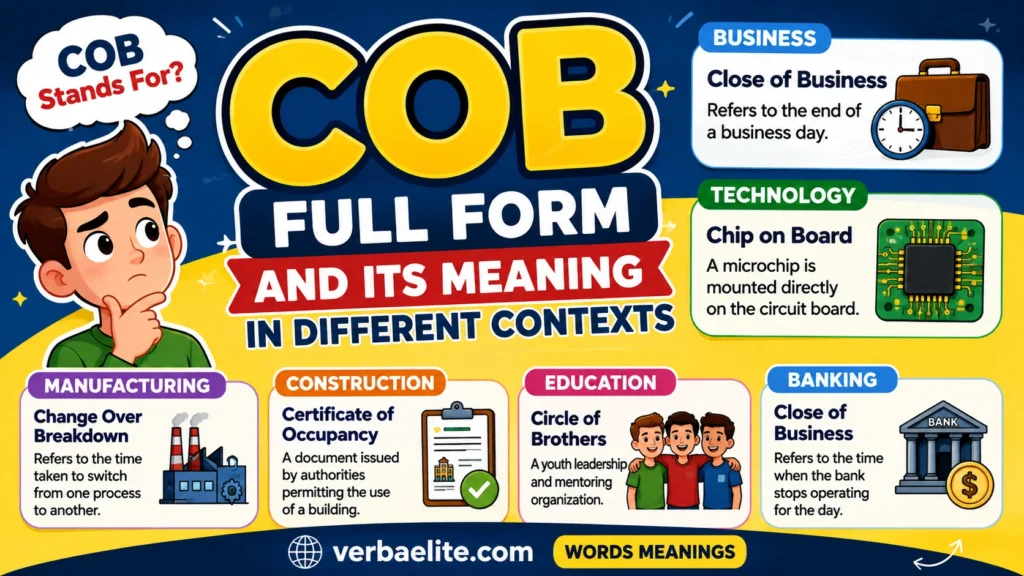
COB generally retains the meaning Close of Business, but its practical interpretation can change depending on the situation.
| Context | Meaning | Typical Use |
| Workplace | Close of Business | Task deadlines |
| Finance | Business-day cutoff | Transactions and requests |
| Customer service | End of working day | Customer responses |
| Project management | End of business day | Milestones |
| Banking | Business closing time | Processing deadlines |
| Corporate email | End of normal working hours | Instructions |
The important point is that COB refers to a business closing point rather than one universally fixed clock time.
COB vs EOD: What Is the Difference?
One of the most common sources of confusion is the difference between COB and EOD.
COB
COB = Close of Business
It emphasizes the point at which the organization’s normal business operations close.
EOD
EOD = End of Day
It generally refers to the end of the day and is also frequently used as a workplace deadline.
For example:
“Please send the report by COB.”
and
“Please send the report by EOD.”
may communicate essentially the same practical deadline in many workplaces.
However, COB is more explicitly connected with business operating hours, while EOD can be interpreted more broadly.
COB vs EOD Table
| Abbreviation | Full Form | Main Meaning |
| COB | Close of Business | End of business operations |
| EOD | End of Day | End of the day |
| EOB | End of Business | End of business hours |
| EOW | End of Week | End of the working week |
COB vs EOB
EOB means End of Business.
It is very similar to COB and is often used interchangeably with it.
For example:
“Please send the documents by COB.”
and
“Please send the documents by EOB.”
can mean the same thing when used in a workplace.
The preferred abbreviation depends on company culture, industry terminology, and regional usage.
Does COB Mean 5 PM?
Not necessarily.
COB does not automatically mean exactly 5:00 p.m.
Many businesses may finish their standard working day around 5 p.m., but others may close at different times. Some organizations also operate across multiple time zones.
For example, if a company works from 9 a.m. to 5 p.m., COB may effectively mean 5 p.m. local business time. Another organization might have a working day that ends at 6 p.m.
For an important deadline, a clearer email would be:
“Please submit the report by 5:00 p.m. Friday.”
This removes ambiguity.
Does COB Mean the Same Thing as 5 PM?
COB can correspond to 5 p.m., but it does not universally mean 5 p.m.
The correct interpretation depends on the organization’s working hours.
If your company has clearly defined business hours, COB normally refers to the end of those hours.
If the recipient is in another time zone, specifying the time zone can make the instruction even clearer:
“Please send the report by 5:00 p.m. PKT on Friday.”
How to Use COB Correctly in an Email
Using COB is simple, but clarity matters.
Basic structure
Please + action + by COB.
Examples:
- Please send the file by COB.
- Please complete the form by COB today.
- We need your approval by COB Friday.
- Kindly provide the requested information by COB tomorrow.
- Please submit your feedback by COB Monday.
You can also place a specific date next to COB:
“Please submit the final version by COB August 14.”
This makes the deadline clearer.
Is COB Formal or Informal?
COB is generally considered professional business terminology.
It is suitable for:
- Workplace emails
- Corporate communication
- Internal messages
- Project discussions
- Business correspondence
- Client communication
- Professional reports
However, not every audience will understand workplace abbreviations.
If you are communicating with a new client, student, customer, or international audience, writing “Close of Business” the first time can be more accessible.
For example:
“Please send the completed form by Close of Business (COB) Friday.”
After that, COB can be used normally.
Common Mistakes When Using COB
1. Assuming COB Always Means 5 PM
This is one of the most common mistakes.
COB depends on the relevant organization’s business hours. Do not assume every company closes at exactly 5 p.m.
2. Using COB Without a Date
“Please send it by COB” may be unclear if several days are being discussed.
Better:
“Please send it by COB Friday.”
3. Ignoring Time Zones
International teams may have different business hours.
Instead of:
“Please send it by COB.”
consider:
“Please send it by COB Friday, Pakistan time.”
4. Using COB for an Urgent Exact-Time Deadline
If a task must arrive at a precise time, give the exact time.
Instead of:
“Send the files by COB.”
write:
“Send the files by 3:00 p.m. Friday.”
5. Assuming Everyone Knows the Abbreviation
Professional abbreviations can vary between industries and regions. When communicating with a general audience, spelling out Close of Business can prevent confusion.
COB Usage Guide: Do and Don’t
Do
- Use COB for professional deadlines.
- Include the date when possible.
- Clarify the time zone for international teams.
- Define COB when communicating with unfamiliar audiences.
- Use exact times when precision is important.
- Consider the organization’s normal working hours.
Don’t
- Assume COB always means 5 p.m.
- Use COB when the deadline is midnight.
- Leave an important date ambiguous.
- Assume every reader understands workplace abbreviations.
- Use COB when an exact clock time is required.
- Confuse COB with a universal worldwide business closing time.
Natural Email Sentences Using COB
Here are some natural examples you can adapt:
Professional:
“Please send the final report by COB Friday.”
Polite:
“Could you please share the updated document by COB tomorrow?”
Direct:
“We need the completed form by COB today.”
Team-oriented:
“Please send your feedback by COB so we can finalize the proposal.”
Client-focused:
“We will provide you with an update by COB.”
Formal:
“Kindly submit the requested documents by COB Monday.”
Why Clear Deadlines Matter in Professional Writing
COB is useful because business writing values concise communication. A short abbreviation can communicate a deadline without making the email unnecessarily long.
However, effective professional writing is not simply about being brief. It is about being clear, precise, and difficult to misunderstand.
Compare:
“Please send it soon.”
with:
“Please send the final report by COB Thursday.”
The second sentence gives the recipient a much clearer expectation.
When a deadline has financial, legal, operational, or customer-service consequences, an exact date and time may be preferable to COB.
COB in Different English-Speaking Workplaces
The phrase Close of Business is widely recognizable in professional English, but workplace conventions can differ.
In some organizations, COB may be used frequently. In others, employees may prefer:
- EOD — End of Day
- EOB — End of Business
- By the end of the working day
- By close of business
- By 5 p.m.
The safest choice depends on your audience.
For international business communication, specific dates, times, and time zones are often clearer than relying only on an abbreviation.
FAQs:
1. What is the full form of COB in email?
COB stands for Close of Business. In email communication, it usually indicates that a task, response, document, or request should be completed before the end of the organization’s normal working day. The exact time can vary by company, so COB should not automatically be interpreted as a specific hour such as 5 p.m.
2. What does COB mean in a work email?
In a work email, COB means Close of Business and is normally used to communicate a deadline. For example, “Please submit the report by COB” means the report should be submitted before the business day ends. If the deadline is important, adding the date and exact time can make the instruction more precise.
3. Does COB mean 5 PM?
No. COB does not universally mean 5 p.m. It refers to the close of normal business operations, and each organization may have different working hours. A company that operates from 9 a.m. to 5 p.m. might treat 5 p.m. as COB, while another company could have a different closing time.
4. What is an example of COB in an email?
A common example is: “Please send the completed report by COB Friday.” This tells the recipient that the report should be submitted before the close of business on Friday. Another example is, “We will provide an update by COB,” meaning the sender expects to provide the update before the business day ends.
5. What is the difference between COB and EOD?
COB means Close of Business, while EOD means End of Day. In many workplaces, both are used to communicate essentially the same deadline. COB is more directly associated with the end of business operations, whereas EOD can refer more generally to the end of the day.
6. Is COB professional in emails?
Yes. COB is a common professional abbreviation and can be appropriate for workplace emails, project communication, finance, customer service, and corporate correspondence. However, if the recipient may not understand the abbreviation, write “Close of Business” instead or define it the first time you use it.
7. How should students understand COB?
Students can understand COB as the end of a normal business working day. For example, if a teacher explains that an assignment must be submitted by COB, the student should confirm the expected business hours because COB is primarily a workplace term and does not automatically identify a universal clock time.
8. Can COB be used with a date?
Yes, and using a date often makes COB clearer. For example, “Please submit the form by COB Monday” identifies the intended business day. For international communication, you can make the instruction even more precise by adding the exact time and time zone.
9. Is COB the same as EOB?
Yes, COB and EOB are very similar. COB means Close of Business, while EOB means End of Business. Both commonly refer to the end of an organization’s normal working hours. Usage varies by company and region, so either abbreviation may be preferred depending on workplace conventions.
10. When should I avoid using COB?
Avoid relying on COB when an exact deadline is important or when the recipient may not understand business abbreviations. In those situations, write a specific date and time, such as “Please submit the document by 5:00 p.m. Friday.” This is especially useful when working across countries, companies, or time zones.
Conclusion:
COB in email means “Close of Business.” It is a professional abbreviation used mainly to indicate that something should be completed, submitted, or communicated before the end of the normal business day.
Although many workplaces may interpret COB as around 5 p.m., there is no universal time attached to it. Business hours can differ between organizations and time zones.
For everyday professional emails, COB is concise and useful. For critical deadlines, however, an exact date, time, and time zone provide greater clarity.
Once you understand this distinction, phrases such as “Please send the report by COB Friday” become straightforward: the sender simply wants the report before the business day closes.

I am Naqash Ayub, the content creator behind VerbaElite, where I simplify full forms, abbreviations, and their meanings into easy to understand explanations. My goal is to provide accurate, reader friendly, and well researched content that helps students, professionals, and everyday readers quickly find the information they need.