
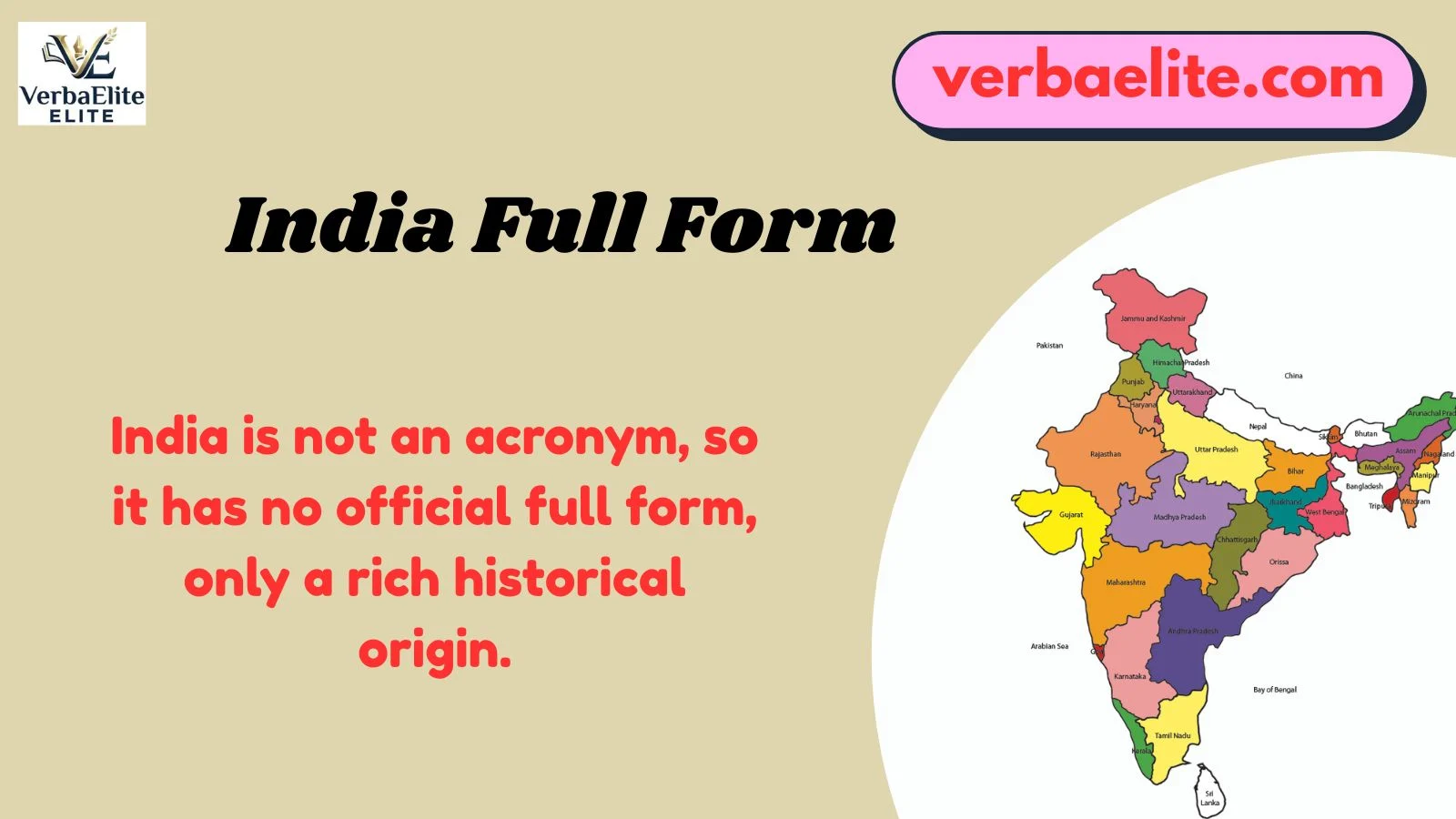
Many people search for the India full form, expecting it to have an official expansion like NASA or UNESCO. In reality, India is not an acronym, so it has no officially recognized full form.
The name has a rich historical origin that dates back thousands of years and is linked to the ancient Indus River.
Many people search for the full form of India, expecting it to be an official abbreviation like NASA or UNESCO.
Surprisingly, the truth is quite different. While several popular full forms circulate online, none of them are officially recognized by the Government of India.
Understanding the real origin of the country’s name helps clear up this common misconception.
name helps clear up this common misconception.
India has no official full form. The word India is a proper name derived from the River Indus and is not an acronym. Although several unofficial expansions exist, none are recognized by the Government of India.
India does not have an official full form because it is a country’s proper name rather than an abbreviation. The name originated from the River Indus and has historical roots dating back thousands of years. While many unofficial expansions are shared online, they are creative interpretations rather than legally or historically accepted meanings.
What Is the Full Form of India?
The simple answer is:
India has no official full form.
Unlike abbreviations such as UNESCO, NASA, or FIFA, the word India was never created by combining the first letters of multiple words. Instead, it is a historical name that evolved over centuries.
Many websites publish creative full forms, but these are unofficial and should not be treated as factual information.
Is INDIA an Acronym?
No.
An acronym is a word formed from the first letters of several words. For example:
- NASA – National Aeronautics and Space Administration
- UNESCO – United Nations Educational, Scientific and Cultural Organization
- FIFA – Fédération Internationale de Football Association
India does not belong to this category. It is simply the name of a country.
Why Do People Search for the India Full Form?
Many students and internet users assume every capitalized word has a full form.
People commonly search this topic because they:
- Need answers for school assignments.
- Prepare for competitive exams.
- See unofficial full forms on social media.
- Want to know the country’s historical meaning.
- Confuse proper names with abbreviations.
Understanding this difference prevents misinformation.
Origin of the Name India
The name India has a fascinating historical journey.
River Indus
The word “India” comes from the Indus River, one of the oldest rivers in South Asia.
Persian Influence
Ancient Persians referred to the river as Hindu, since they pronounced the Sanskrit “Sindhu” differently.
Greek Influence
Greek historians later adapted the name to Indos, which eventually became India in Latin and English.
This historical evolution explains why the country came to be known internationally as India.
What Does the Constitution Say?
The Constitution of India begins with these famous words:
“India, that is Bharat, shall be a Union of States.”
This means both India and Bharat are official names of the country.
Neither name is an acronym.
Is There an Official Full Form of INDIA?
No.
There is no official government document that defines India as an acronym.
Government departments, educational institutions, and constitutional authorities do not recognize any expanded version of the word India.
Whenever you see a “full form” online, remember that it is usually a creative phrase rather than an official definition.
Popular Unofficial Full Forms of INDIA
Although unofficial, people often create meaningful expansions such as:
| Unofficial Full Form | Meaning |
|---|---|
| Independent Nation Declared In August | Refers to India’s independence in August 1947 |
| Independent National Democratic Intelligent Area | A creative internet expansion |
| Intelligent Nation Developing In Action | Motivational interpretation |
| Incredible Nation Developing In Achievement | Inspirational version |
| Independent Nation Dedicated to Integrity and Advancement | Patriotic phrase |
Important: None of these are officially recognized.
India vs Bharat
Many people wonder whether India and Bharat are different.
The answer is simple:
| India | Bharat |
|---|---|
| Internationally used name | Traditional Indian name |
| Derived from Indus | Derived from Sanskrit |
| Appears in English documents | Used in Hindi and several Indian languages |
| Official constitutional name | Also an official constitutional name |
Both refer to the same country.
Why Is India Called Bharat?
The name Bharat comes from ancient Indian traditions and historical literature.
Many historians associate it with King Bharata, a legendary ruler mentioned in ancient texts.
Because of its cultural importance, Bharat remains one of India’s official names today.
Common Myths About India’s Full Form
Myth 1
India officially stands for “Independent Nation Declared In August.”
Reality: False. This is an unofficial expansion.
Myth 2
The government has approved a full form.
Reality: No official approval exists.
Myth 3
Every country has a full form.
Reality: Most countries do not have acronym-based names.
Examples:
- India
- Japan
- China
- Brazil
- Canada
These are proper names, not abbreviations.
Interesting Facts About the Name India
- The name has existed for over two thousand years.
- It originated from the Indus River.
- Ancient Greeks helped popularize the name.
- Bharat and India are both official constitutional names.
- India is not an acronym.
- Many unofficial full forms are motivational rather than factual.
- School exams usually expect the answer that India has no official full form.
- The name reflects centuries of cultural and historical evolution.
Why Do Unofficial Full Forms Become Popular?
Unofficial expansions spread because they are:
- Easy to remember
- Patriotic
- Shared on social media
- Used in speeches and presentations
- Motivational for students
However, they should not replace historical facts.
Quick Comparison
| Question | Correct Answer |
|---|---|
| Official full form of India | None |
| Is India an acronym? | No |
| Origin of the name | Indus River |
| Official names | India and Bharat |
| Government-approved full form | No |
| Common internet full forms | Unofficial |
History of the Name India
The name India has a long and fascinating history that dates back thousands of years. Unlike an acronym, it evolved through different civilizations, languages, and cultures. Understanding its origin helps explain why India has no official full form and why the country’s name is deeply connected to geography and history.
The Origin of the Word “India”
The name India is derived from the Indus River, one of the oldest and most significant rivers in South Asia. In ancient Sanskrit, the river was called Sindhu, which means “river” or “large body of flowing water.”
Over time, different civilizations pronounced the word differently:
- Sanskrit: Sindhu
- Old Persian: Hindu
- Greek: Indos
- Latin: India
- English: India
As trade and cultural exchanges expanded, the name gradually became recognized worldwide as India.
The Role of the Indus River
The Indus River played a major role in shaping the identity of the Indian subcontinent. One of the world’s earliest urban civilizations, the Indus Valley Civilization, flourished along its banks around 3300 BCE to 1300 BCE.
Because the river was central to trade, agriculture, and settlement, neighboring civilizations began identifying the surrounding land by the river’s name. This geographical association eventually gave rise to the name India.
Evolution of the Name Through History
The journey of the name India spans several ancient cultures.
1. Sanskrit Period
Ancient Indian texts referred to the Indus River as Sindhu. The surrounding region was also associated with this name.
2. Persian Influence
When the Persians came into contact with the region, they pronounced Sindhu as Hindu because the “S” sound often changed to “H” in Old Persian.
3. Greek Influence
Greek historians, including those who documented the campaigns of Alexander the Great, adapted the Persian name into Indos. This version became widely known in the Western world.
4. Latin and European Usage
The Romans later used the Latin form India, and European explorers continued using this name in maps, documents, and historical records.
5. Modern Recognition
Today, India is the internationally recognized English name of the country, while Bharat is its traditional and constitutional name.
India in the Constitution
The Constitution of India clearly recognizes two official names for the country.
Article 1 of the Constitution states:
“India, that is Bharat, shall be a Union of States.”
This statement confirms that:
- India is an official name.
- Bharat is also an official name.
- Both names refer to the same sovereign nation.
- Neither name is an abbreviation or has an official full form.
This constitutional recognition removes the confusion about whether one name is more official than the other.
India vs Bharat vs Hindustan
Many people wonder whether India, Bharat, and Hindustan have different meanings. While all three names are associated with the same country, they have different historical and cultural backgrounds.
| Name | Origin | Common Usage |
|---|---|---|
| India | Derived from the Indus River | International and English-language use |
| Bharat | Ancient Sanskrit traditions and historical texts | Official name used in many Indian languages |
| Hindustan | Persian origin meaning “Land of the Hindus” | Historical, cultural, and poetic usage |
Among these, only India and Bharat are recognized in the Constitution.
Why Doesn’t India Have an Official Full Form?
Many people assume that every well-known name must have a full form, but that is not true.
Countries are proper nouns, not abbreviations. Their names usually originate from:
- Historical events
- Ancient civilizations
- Rivers or mountains
- leagues or kingdoms
- Indigenous languages
- Geographic features
Since India evolved naturally over centuries, it was never created as an acronym. Therefore, it does not have an official expanded form.
Popular Unofficial Full Forms of India
Although there is no official full form, many creative expansions are shared on social media, websites, and motivational posters.
Some examples include:
| Unofficial Full Form | Purpose |
|---|---|
| Independent Nation Declared In August | Patriotic expression |
| Incredible Nation Developing In Action | Inspirational phrase |
| Intelligent Nation Driving Innovation and Achievement | Motivational interpretation |
| Independent Nation Dedicated to Integrity and Advancement | Creative expansion |
| Inspiring Nation of Diversity, Intelligence, and Achievement | Educational slogan |
These versions are not recognized by the Government of India and should be viewed as creative expressions rather than factual definitions.
Why Do These Unofficial Full Forms Become Popular?
Unofficial full forms gain popularity because they:
- Are easy to remember.
- Sound motivational and patriotic.
- Spread quickly on social media.
- Are often shared in school projects and presentations.
- Encourage positive messages about the country.
While these phrases can be inspiring, they should never be confused with official or historical facts.
Common Misconceptions About India Full Form
Many myths surround the term India full form. Here are some of the most common ones.
Myth 1: India officially stands for “Independent Nation Declared In August.”
Fact: There is no government-approved full form of India.
Myth 2: Every country’s name has a full form.
Fact: Most countries have proper names, not acronyms.
Myth 3: Bharat and India are different countries.
Fact: Both names refer to the same nation and are officially recognized.
Myth 4: The full forms found on social media are historically accurate.
Fact: They are creative interpretations with no constitutional or historical basis.
Quick Summary
- The name India originated from the ancient Indus River.
- The word evolved from Sindhu → Hindu → Indos → India.
- India and Bharat are both official names recognized by the Constitution.
- India is not an acronym, so it has no official full form.
- Popular internet full forms are creative but unofficial.
- Understanding the history of the name helps separate facts from myths.
FAQs:
What is the official full form of India?
India does not have an official full form. It is a proper name, not an acronym. The name originated from the ancient Indus River and has been used for centuries. Any expanded versions you see online are unofficial and are not recognized by the Government of India.
Is India an acronym?
No. An acronym is formed by taking the initial letters of multiple words, such as NASA or UNESCO. The word India was not created this way. It is a historical name that evolved through different languages and civilizations over thousands of years.
Why do people search for the India full form?
Many people believe that every capitalized word has a full form. Students often search for the India full form for school assignments, competitive exams, quizzes, or general knowledge. This has also become a popular internet search because many unofficial full forms are widely shared on social media.
What is the origin of the name India?
The name India comes from the Indus River, which was known as Sindhu in ancient Sanskrit. Over time, the Persians pronounced it as Hindu, the Greeks changed it to Indos, and the Romans later used the name India, which became the internationally accepted English name.
Are India and Bharat the same?
Yes. India and Bharat are the two official names of the country. Article 1 of the Constitution states, “India, that is Bharat, shall be a Union of States.” Both names refer to the same nation and are equally valid in official contexts.
Are the full forms of India found online correct?
No. Most full forms shared online are creative or motivational phrases. They may be inspiring, but they are not historically accurate or officially recognized. If you are writing an assignment or preparing for an exam, always mention that India has no official full form.
Why is India called Bharat?
The name Bharat has ancient roots in Indian history and Sanskrit literature. It is traditionally associated with King Bharata, a legendary ruler mentioned in ancient texts. Because of its historical and cultural significance, Bharat is recognized as one of the country’s official names.
Do other countries have official full forms?
Most countries do not have official full forms because their names are proper nouns rather than abbreviations. Countries such as Japan, China, Canada, Brazil, and India are known by historical names instead of acronym-based names.
What should students write in exams?
If an exam asks for the full form of India, the correct answer is:
India has no official full form because it is not an acronym.
If your teacher asks for a popular or creative full form, mention clearly that it is unofficial and include a note that it is not recognized by the Government of India.
What is the difference between an official and an unofficial full form?
An official full form is recognized by a government or organization and appears in official documents. An unofficial full form is a creative or motivational phrase made by individuals. India belongs to the second category, meaning all popular full forms are unofficial interpretations rather than factual definitions.
Conclusion:
Many people search for the India full form, expecting it to be an official abbreviation. However, the truth is that India has no officially recognized full form because it is a historical name rather than an acronym.
Its origin can be traced back to the ancient Indus River, and over centuries it evolved through Sanskrit, Persian, Greek, and Latin influences before becoming the internationally accepted name we use today.
Understanding the difference between historical facts and unofficial internet interpretations is essential, especially for students, educators, and competitive exam aspirants.
While creative full forms can be inspiring, they should never be confused with official information. If you remember one key point from this article, let it be this:

I am Naqash Ayub, the content creator behind VerbaElite, where I simplify full forms, abbreviations, and their meanings into easy to understand explanations. My goal is to provide accurate, reader friendly, and well researched content that helps students, professionals, and everyday readers quickly find the information they need.