
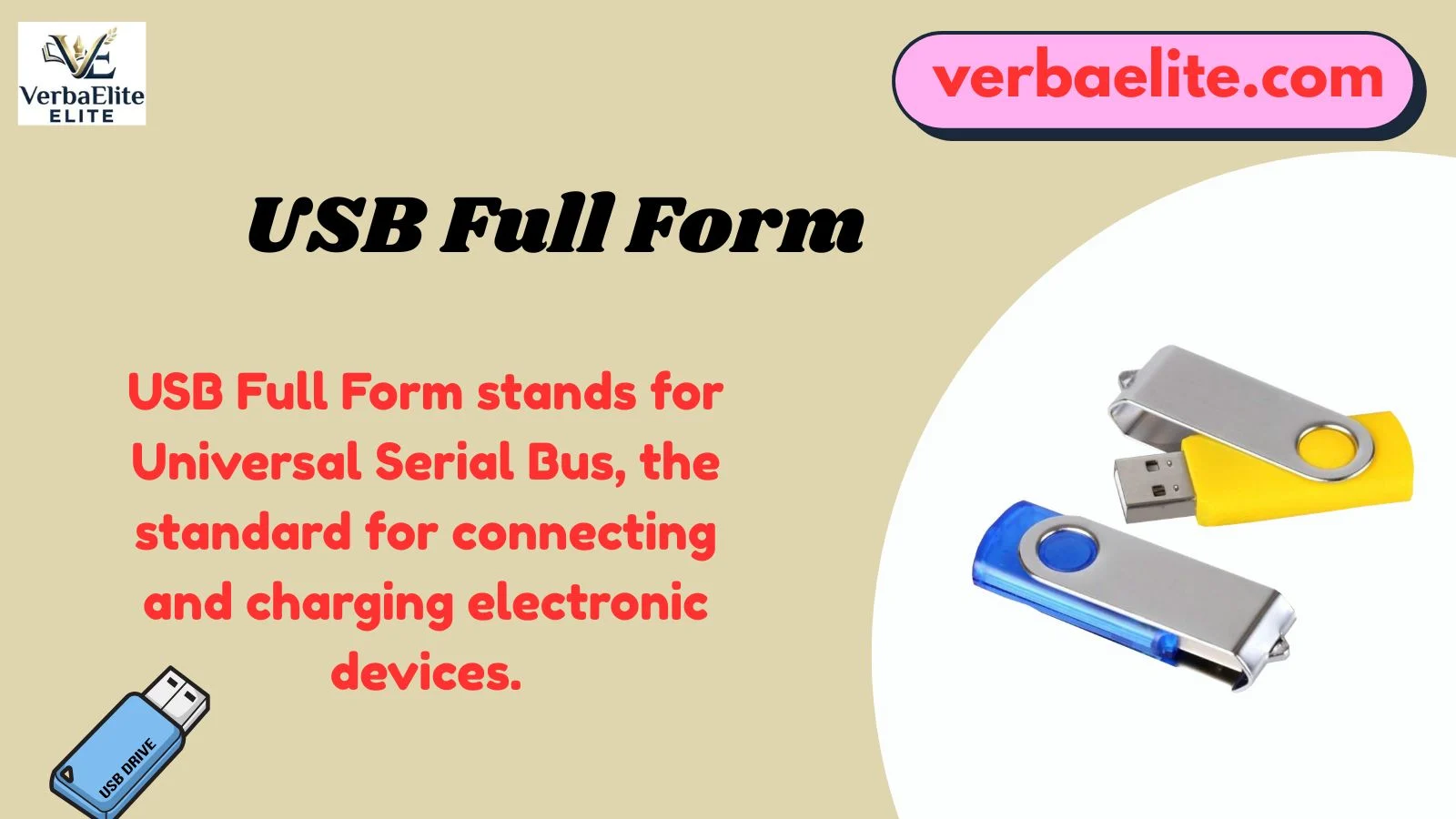
Have you ever plugged a flash drive into your computer and wondered what USB actually stands for?
Almost every modern device from laptops and smartphones to printers and gaming consoles relies on USB technology for charging, data transfer, and connectivity. Despite using it daily, many people don’t know its full form or how it works.
In this guide, you’ll learn the USB full form, its meaning, history, different types, versions, practical uses, and why it has become the universal standard for connecting electronic devices.
Whether you’re a student, tech enthusiast, or simply curious, this guide explains everything in clear and simple language.
USB stands for Universal Serial Bus. It is a standard technology used to connect electronic devices for data transfer, charging, and communication between computers, smartphones, printers, storage devices, and other peripherals.
What Is the Full Form of USB?
The full form of USB is Universal Serial Bus.
It is an industry-standard interface developed to simplify the connection between computers and external devices. USB allows multiple devices to communicate efficiently while providing electrical power and transferring data through a single cable.
Today, USB is one of the most widely used connection standards in the world. From charging smartphones to connecting keyboards, external hard drives, cameras, speakers, and gaming accessories, USB has become an essential part of everyday technology.
USB Full Form Breakdown
| Letter | Full Word | Meaning |
|---|---|---|
| U | Universal | Designed to work with a wide range of electronic devices. |
| S | Serial | Transfers data one bit at a time in a continuous sequence. |
| B | Bus | A communication system that allows devices to exchange data with a computer. |
AI Overview Optimized Block
Universal Serial Bus (USB) is a universal hardware interface used to connect electronic devices for data communication and power delivery. It standardizes how devices communicate, making connections faster, easier, and compatible across different manufacturers and operating systems.
What Is USB?
USB is a hardware interface and communication standard that enables computers and electronic devices to exchange data and supply power through a single connection.
Before USB became popular, computers required different connectors for keyboards, mice, printers, and storage devices. USB simplified this by introducing one universal connection standard that could support numerous peripherals without requiring separate ports for each device.
Today, USB technology supports:
- Data transfer
- Device charging
- Power delivery
- Audio transmission
- Video output (on supported USB-C devices)
- Peripheral connectivity
Its ease of use, plug-and-play functionality, and broad compatibility have made USB the global standard for connecting electronic devices.
Why Is USB Called Universal Serial Bus?
The name Universal Serial Bus reflects its purpose:
- Universal because it works with thousands of different devices regardless of manufacturer.
- Serial because it transfers information sequentially through serial communication.
- Bus because it acts as the communication pathway between connected devices and the host computer.
This standardized design replaced multiple proprietary connectors, making computers easier to use and reducing hardware compatibility issues.
Key Features of USB
USB offers several advantages that have made it the preferred connectivity standard worldwide.
- Universal compatibility across devices
- Fast data transfer speeds
- Plug-and-play installation
- Hot-swappable connections without restarting the device
- Simultaneous power delivery and data transfer
- Compact and durable connectors
- Support for charging smartphones, tablets, and laptops
- Backward compatibility with many earlier USB versions
These features have allowed USB technology to remain relevant for decades while continuously evolving to meet modern computing needs.
History of USB
Before USB was introduced, connecting devices to a computer was often complicated. Different peripherals required different ports, cables, and software, making installation difficult for many users.
To solve this problem, several leading technology companies collaborated to create a single connection standard that would work across multiple devices. The first USB specification was released in 1996, and it quickly became the preferred interface for computers and accessories.
Over the years, USB has evolved significantly, offering faster data transfer speeds, improved power delivery, and smaller, more versatile connectors. Today, USB is used in billions of devices worldwide and continues to be one of the most important hardware standards in modern technology.
Types of USB Connectors
USB connectors come in different shapes and sizes to support various devices. Each type is designed for specific purposes while maintaining compatibility with USB standards.
USB Type-A
USB Type-A is the most recognizable USB connector. It has a rectangular shape and is commonly found on desktop computers, laptops, gaming consoles, televisions, and chargers.
Common Uses
- Flash drives
- Keyboards
- Computer mice
- External hard drives
- USB hubs
Features
- Standard rectangular connector
- Widely supported
- Durable and reliable
- Available in USB 2.0, USB 3.0, and newer versions
USB Type-B
USB Type-B connectors are mostly used with larger peripheral devices that connect to computers.
Common Uses
- Printers
- Scanners
- Audio equipment
- External storage devices
Features
- Square-shaped connector
- Stable connection
- Designed primarily for peripheral devices
Mini USB
Mini USB connectors were once popular in portable electronics but are now largely obsolete.
Common Uses
- Older digital cameras
- MP3 players
- GPS devices
Features
- Smaller than Type-A and Type-B
- Supports charging and data transfer
- Mostly replaced by Micro USB and USB-C
Micro USB
Micro USB became the standard charging connector for Android smartphones before USB-C was introduced.
Common Uses
- Android phones (older models)
- Bluetooth speakers
- Power banks
- Digital cameras
- Portable accessories
Features
- Compact size
- Affordable
- Supports charging and data transfer
- Still found on many budget electronics
USB Type-C
USB Type-C is the latest and most advanced USB connector. It is compact, reversible, and supports extremely fast charging and data transfer.
Common Uses
- Modern smartphones
- Laptops
- Tablets
- Gaming devices
- External SSDs
- Monitors
Features
- Reversible design
- Faster charging
- High-speed data transfer
- Supports video output
- Compatible with USB Power Delivery
- Future-proof connector
USB Versions
USB technology has improved through multiple generations. Each new version increases speed, efficiency, and functionality.
| USB Version | Maximum Speed | Main Improvement |
|---|---|---|
| USB 1.0 | 1.5 Mbps | First USB standard |
| USB 1.1 | 12 Mbps | Better reliability |
| USB 2.0 | 480 Mbps | High-speed data transfer |
| USB 3.0 | 5 Gbps | SuperSpeed performance |
| USB 3.1 | 10 Gbps | Faster transfers and efficiency |
| USB 3.2 | Up to 20 Gbps | Multiple-lane communication |
| USB4 | Up to 40 Gbps | High performance, video support, and advanced power delivery |
Common Uses of USB
USB technology is used in nearly every modern electronic device. Its versatility makes it suitable for both personal and professional applications.
Data Transfer
USB allows users to transfer documents, videos, photos, music, and software between computers and storage devices quickly and securely.
Charging Devices
Most smartphones, tablets, earbuds, smartwatches, and laptops use USB cables for charging.
Connecting Computer Accessories
USB enables easy connection of:
- Keyboard
- Mouse
- Webcam
- Printer
- Scanner
- Speakers
- Microphone
External Storage
USB flash drives and external hard drives provide portable storage for backups and file sharing.
Gaming
Gaming controllers, headsets, keyboards, mice, and accessories commonly connect through USB ports.
Multimedia
USB supports audio and video transmission on compatible devices, especially through USB-C technology.
Industrial Applications
Factories, medical equipment, automotive systems, and embedded devices also rely on USB for communication and maintenance.
Advantages of USB
USB has remained the industry standard because it offers several practical benefits.
- Universal compatibility with most electronic devices
- Easy plug-and-play installation
- Fast and reliable data transfer
- Simultaneous charging and communication
- Compact and portable connectors
- Supports a wide range of accessories
- Reduced cable clutter
- Cost-effective solution
- Backward compatibility with many previous versions
- Widely available around the world
Disadvantages of USB
Although USB is highly efficient, it has some limitations.
- Different connector types can create compatibility issues.
- Older USB versions are much slower than newer ones.
- Some USB cables only support charging and not data transfer.
- Performance depends on the device, cable quality, and USB version.
- High-speed features may not be available on older hardware.
USB vs Other Common Connection Technologies
Although USB is the most popular connection standard, it is not the only one. Different technologies serve different purposes depending on speed, compatibility, and device requirements.
| Technology | Primary Purpose | Data Transfer | Power Delivery | Common Devices |
|---|---|---|---|---|
| USB | Data transfer and charging | Yes | Yes | Computers, smartphones, flash drives |
| HDMI | Audio and video output | Video & Audio | Limited | TVs, monitors, gaming consoles |
| Ethernet | Internet connection | Yes | No | Computers, routers |
| Bluetooth | Wireless communication | Yes | Limited | Earbuds, keyboards, speakers |
| Thunderbolt | High-speed data and video | Yes | Yes | Professional laptops, monitors |
USB remains the most versatile option because it combines charging, communication, and data transfer through a single cable.
How to Choose the Right USB Cable
Not all USB cables perform the same. Choosing the right cable depends on your device and intended use.
Consider the Connector Type
Make sure the cable matches your device, such as USB-A, Micro USB, or USB-C.
Check Data Transfer Speed
If you frequently move large files, choose cables that support USB 3.0, USB 3.2, or USB4 speeds.
Verify Charging Support
Some cables are designed only for charging, while others support both charging and data transfer.
Buy Quality Cables
Certified, high-quality cables are safer, last longer, and provide better performance than inexpensive alternatives.
Common Devices That Use USB
USB technology is integrated into countless electronic products.
- Desktop computers
- Laptops
- Smartphones
- Tablets
- USB flash drives
- External SSDs and hard drives
- Keyboards
- Computer mice
- Printers
- Scanners
- Digital cameras
- Gaming controllers
- Smart TVs
- Bluetooth speakers
- Webcams
- Power banks
- Smartwatches
FAQs:
What is the full form of USB?
The full form of USB is Universal Serial Bus. It is a standard interface used to connect electronic devices for transferring data, charging batteries, and enabling communication between devices.
Is USB used only for computers?
No. USB is used with computers, smartphones, tablets, printers, gaming consoles, cameras, smart TVs, speakers, and many other electronic devices.
What is the latest USB version?
USB4 is currently the latest major USB standard. It provides faster data transfer, improved power delivery, and enhanced support for video output compared to earlier versions.
What is the difference between USB Type-A and USB Type-C?
USB Type-A is the traditional rectangular connector, while USB Type-C is smaller, reversible, and supports faster charging, higher data transfer speeds, and advanced features like video output.
Can a USB cable charge and transfer data?
Yes. Most modern USB cables support both charging and data transfer. However, some low-cost cables are designed only for charging and do not support file transfers.
Why is USB called Universal Serial Bus?
It is called Universal because it works with many devices, Serial because it transfers data sequentially, and Bus because it serves as the communication pathway between connected devices.
What are the main uses of USB?
USB is commonly used for charging devices, transferring files, connecting peripherals like keyboards and printers, powering accessories, and linking external storage devices.
Is USB backward compatible?
Yes. Most newer USB versions are backward compatible with older versions. However, data transfer speed is generally limited to the capability of the oldest connected device or cable.
Which USB connector is most commonly used today?
USB Type-C has become the most widely adopted connector for modern smartphones, tablets, laptops, and many other electronic devices because of its reversible design and advanced capabilities.
What are the advantages of USB?
USB offers universal compatibility, fast data transfer, plug-and-play functionality, reliable charging, wide device support, and ease of use, making it one of the most popular connectivity standards in the world.
Conclusion:
The USB full form is Universal Serial Bus, a technology that has transformed the way electronic devices connect, communicate, and receive power.
From transferring files and charging smartphones to connecting printers, keyboards, and external storage devices, USB has become an essential part of everyday life.
As USB technology continues to evolve with faster versions and more capable connectors like USB Type-C and USB4, it remains the universal standard for modern connectivity.
Understanding how USB works, its different types, versions, and practical applications helps users choose the right cables and devices while making the most of today’s technology

I am Naqash Ayub, the content creator behind VerbaElite, where I simplify full forms, abbreviations, and their meanings into easy to understand explanations. My goal is to provide accurate, reader friendly, and well researched content that helps students, professionals, and everyday readers quickly find the information they need.