
Ever reached the end of a letter and noticed PS followed by one more thought?
It looks small, but these two letters can add an important message after the main text.
So, what exactly does PS stand for, and when should you use it
PS stands for “Postscript,” meaning a message or additional thought added after the main body of a letter, email, or message.
PS means Postscript, an additional note written after the main body of a letter, email, or message. It is used to add information, reminders, personal comments, or thoughts that were not included in the original text.
What Is the PS Full Form?
The PS full form is “Postscript.” The word comes from the Latin phrase post scriptum, which means “written after.”
A PS is used when someone wants to add an extra point after finishing the main message. It is especially common in personal letters, informal emails, notes, cards, and online communication.
For example:
PS: Don’t forget to bring your camera tomorrow.
The main message has already ended, but the writer remembers another useful detail. Instead of rewriting the entire message, they add it as a PS.
Simple meaning of PS
PS = Postscript = an additional message written after the main text.
The abbreviation is usually written as PS, although P.S. is also a traditional form.
What Does Postscript Mean?
A postscript is something written after the main content of a message has been completed.
The term comes from Latin:
- Post = after
- Scriptum = written
Therefore, post scriptum literally refers to something written afterward.
Over time, this phrase was shortened to PS in English writing.
Why do people use PS?
People use PS when they:
- Remember an important detail after finishing a message
- Want to add a reminder
- Want to make a personal comment
- Want to emphasize an extra point
- Want to add humor or warmth
- Do not want to interrupt the main flow of the message
How Is PS Used in Writing?
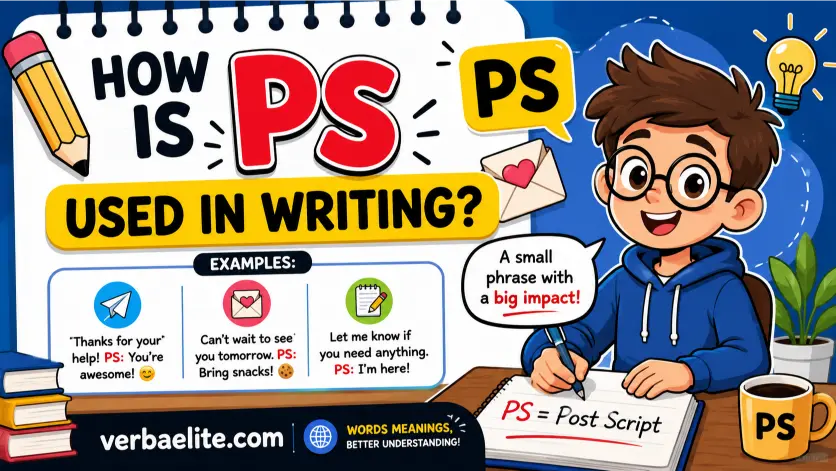
PS traditionally appears after the main body and signature of a letter.
Basic format
Dear Sarah,
Thank you for helping me with the project. I really appreciate your support.
Best wishes,
AliPS: Please send me the final file tomorrow.
The PS works as an additional thought rather than part of the main message.
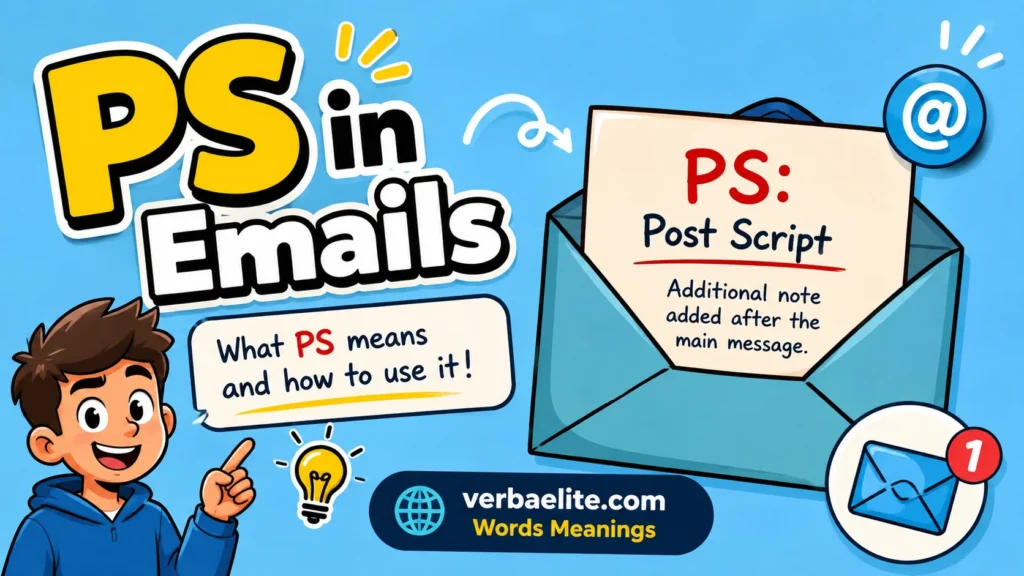
PS in Emails
PS is still used in modern emails, particularly when the tone is personal, friendly, or informal.
Example
Hi Ahmed,
The meeting is scheduled for Friday at 10 a.m. Please bring the updated presentation.
Regards,
HamzaPS: The meeting room has changed to Room 204.
In a formal business email, however, important information should normally be placed in the main body rather than hidden in a PS.
PS in Text Messages and Social Media
The use of PS has expanded beyond traditional letters.
People sometimes use it in:
- Text messages
- WhatsApp messages
- Social media posts
- Online conversations
- Personal notes
- Birthday messages
- Invitations
For example:
Hope you have an amazing birthday! 🎉
PS: Your surprise is waiting for you!
Here, PS creates a conversational and playful ending.
Common Meanings of PS
Although Postscript is the most common meaning in ordinary writing, PS can represent different things depending on the context.
| Context | PS Full Form | Meaning |
|---|---|---|
| Letters and writing | Postscript | An additional note after the main message |
| Politics | Public Service | Government or public-sector-related context |
| Education | Public School | A school operated as part of a public education system |
| Technology | PlayStation | Sony’s video game console brand |
| Medical context | Physician/Specialist abbreviations may vary | Meaning depends on the specific terminology |
| Measurement | Pferdestärke in some contexts | A horsepower-related unit, mainly in automotive contexts |
Important: The intended meaning of PS depends entirely on the sentence and subject area. When someone asks simply for the PS full form in writing, the answer is Postscript.
PS Full Form in English
The PS full form in English is Postscript.
It refers to an additional statement written after the main body of a letter, note, email, or message.
Example:
PS: I forgot to mention that your package has arrived.
The sentence after PS provides information that was added after the main message was completed.
PS Full Form in Chat
In casual chat, PS usually means Postscript.
People use it to introduce an extra thought at the end of a conversation.
Example:
I’ll see you at the restaurant at 8.
PS: Bring your jacket; it might get cold.
It can make a message feel more natural and personal.
PS Full Form in Email
In email communication, PS means Postscript. It is placed near the end of the email, usually after the signature.
Example:
Thanks for your help with the report.
Best,
DanielPS: Let me know if you need the original documents.
For professional emails, use PS sparingly. If the information is essential, it is usually better to include it in the main email.
PS Full Form in a Letter
In a traditional letter, PS means Postscript.
It is used to add something the writer remembered after completing the letter.
Example:
Dear Emma,
I enjoyed your visit last weekend. We should plan another trip soon.
Love,
SophiaPS: I still have your book!
This traditional use is one of the clearest examples of a postscript.
PS vs P.S. — Which Is Correct?
Both PS and P.S. are widely recognized.
- PS — modern, simple style
- P.S. — traditional style with periods
You may also see P.S.: followed by a colon.
For example:
PS: Don’t forget your keys.
or
P.S. Don’t forget your keys.
Both communicate the same basic idea.
12 Examples of PS in Sentences
1. Personal letter
PS: I hope we can meet again soon.
Meaning: The writer adds a personal thought after completing the letter.
Category: Personal writing
2. Friendly email
PS: Thanks again for the coffee!
Meaning: An informal extra comment is added at the end.
Category: Email
3. Reminder
PS: Remember to submit the form by Monday.
Meaning: The writer adds an important reminder.
Category: Reminder
4. Birthday message
PS: Your present is hidden in the closet.
Meaning: The writer adds a surprise-related detail.
Category: Personal message
5. Business communication
PS: The updated document is attached.
Meaning: The writer provides an additional piece of information.
Category: Professional email
6. Invitation
PS: Bring your favorite board game!
Meaning: An extra instruction is added to the invitation.
Category: Invitation
7. Thank-you note
PS: Your kindness meant a lot to me.
Meaning: The writer adds an emotional thought.
Category: Thank-you message
8. Casual chat
PS: Don’t be late this time!
Meaning: A playful reminder is added.
Category: Casual communication
9. Travel message
PS: Check the weather before you leave.
Meaning: The writer adds practical advice.
Category: Travel communication
10. School note
PS: Please bring your science notebook tomorrow.
Meaning: An additional instruction is provided.
Category: School communication
11. Social media
PS: More photos are coming tomorrow.
Meaning: An extra update is added to the post.
Category: Social media
12. Humorous message
PS: Yes, I really did eat the last slice of pizza.
Meaning: A funny confession is added after the main message.
Category: Humor
When Should You Use PS?
PS works best when the additional information is secondary but useful, interesting, emotional, or memorable.
Use it when:
- You remember something after finishing your message.
- You want to add a small reminder.
- You want to make a personal message warmer.
- You want to add humor.
- You want to emphasize a minor point.
- You want to finish with an unexpected thought.
When Should You Avoid PS?
Avoid using PS for information that is essential to understanding the main message.
For example, if an email contains an important deadline, placing that deadline only in the PS may make it easy for the reader to overlook.
Instead, put important information directly in the main body.
PS in Formal vs Informal Writing
| Writing Type | Is PS Appropriate? | Best Use |
| Personal letter | Yes | Extra thoughts or reminders |
| Friendly email | Yes | Personal comments |
| Casual message | Yes | Humor or reminders |
| Birthday card | Yes | Warm closing thought |
| Formal business email | Sometimes | Minor additional information |
| Academic essay | Usually no | Use normal paragraphs instead |
| Research paper | Usually no | Follow the required academic structure |
| Legal document | Generally no | Follow formal document conventions |
The key is context. A PS feels natural in conversational writing but can look unnecessary in highly structured academic or professional writing.
PS vs Main Message
A PS should not become a second main paragraph.
Think of it as a small addition rather than another major section.
Main message
Please send the report by Friday so we can review it before the meeting.
PS
PS: Please also include the updated sales figures.
The main message contains the central request, while the PS adds a secondary detail.
Common Mistakes When Using PS
1. Using PS for the most important information
If the information is essential, put it in the main body.
2. Adding too many PS sections
A long chain of PS, P.P.S., P.P.P.S., and so on can make writing feel cluttered.
3. Using PS in every message
PS is most effective when it genuinely adds something extra.
4. Confusing PS with a subject
PS is not an email subject line. It comes after the main content.
5. Forgetting the context
PS has different meanings in different fields. Always determine its meaning from the surrounding text.
Do and Don’t: PS Usage
Do
- Use PS for an additional thought.
- Keep it short and clear.
- Use it naturally in personal writing.
- Add reminders or friendly comments.
- Place it after the main message and signature when appropriate.
Don’t
- Hide essential information in a PS.
- Add several unnecessary postscripts.
- Use it simply to repeat the main message.
- Treat PS as a replacement for proper organization.
- Assume PS always means Postscript in technical contexts.
Natural Chat Responses Using PS
Here are some realistic examples:
1.
See you tomorrow! PS: Don’t forget the tickets.
2.
Thanks for helping me today. PS: You owe me coffee now! 😄
3.
I’ll send the documents tonight. PS: Check your spam folder if you don’t see them.
4.
Hope you have a great weekend! PS: Take lots of pictures.
5.
The meeting starts at 9. PS: Coffee is on me.
Why Is PS Important in English Writing?
PS is a small but useful part of English communication because it allows writers to add information without restructuring the entire message.
It also demonstrates how language can adapt to different communication purposes. In personal writing, a postscript can create warmth, humor, suspense, or emphasis.
From a writing perspective, PS can function as a final attention-grabbing detail. Because readers have already reached the end of the message, an unexpected PS can stand out.
However, effective writing still depends on organization. A PS should complement the message rather than compensate for poor structure.
How Students Can Use PS
Students may encounter PS when reading:
- Personal letters
- Historical documents
- Novels
- Biographies
- Informal emails
- Creative writing
- Older correspondence
For school assignments, students should understand the term Postscript and recognize how it functions in a text.
If a teacher asks for the meaning of PS, a strong short answer is:
PS stands for Postscript, an additional thought or message written after the main body of a letter or message.
FAQs:
What is the PS full form?
The PS full form is Postscript. It refers to an additional thought, note, or message written after the main body of a letter, email, or other written communication. The term comes from the Latin post scriptum, meaning “written after.” PS is especially common in personal and informal communication.
What does PS mean in a letter?
In a letter, PS means Postscript. It is used to add information after the writer has completed the main message. For example, a person might finish a letter, sign their name, and then write “PS: Don’t forget to call me.” It allows the writer to add a final thought without changing the original letter.
What are some examples of PS?
Examples include PS: Don’t forget your keys, PS: Call me when you arrive, and PS: I enjoyed meeting you. Each statement adds information after the main message has been completed. PS can introduce a reminder, personal comment, useful detail, emotional thought, or humorous remark.
What is a funny PS example?
A funny PS can add humor at the end of an otherwise ordinary message. For example: PS: I ate the last cookie. Please forgive me. Another example is PS: Your secret is safe with me—probably. Funny postscripts work particularly well in friendly messages, cards, and informal emails.
What is a poetic use of PS?
In creative or poetic writing, a PS can create an emotional final moment or unexpected closing thought. A writer might use it to leave the reader with a memorable idea after the main text. For example, a personal poem or letter could end with a PS containing a final reflection, emotional detail, or affectionate thought.
What is the difference between PS and P.S.?
There is essentially no difference in meaning between PS and P.S. Both represent Postscript. P.S. is the traditional form with periods, while PS is a common modern form. Writers can use either depending on their preferred style or the conventions of the publication or organization.
How do you use PS in writing?
Write the main message first, then add the PS afterward when you remember a secondary detail or want to add a final thought. In traditional letters, it usually appears after the signature. Keep it concise and relevant. Important information should normally remain in the main body rather than being placed only in the PS.
Why is PS important in English literature?
PS is useful in English literature and historical writing because postscripts can reveal additional thoughts, emotions, or information. In letters and literary correspondence, an added note may provide context that was not part of the main text. Writers can also use a postscript creatively to produce emphasis, humor, surprise, or emotional impact.
How can students use PS?
Students can use PS when writing informal letters, personal notes, creative assignments, or messages where an additional thought is appropriate. They should understand that PS means Postscript and represents information added after the main message. In formal academic essays, however, students should generally follow the required structure instead of adding a PS.
Does PS always mean Postscript?
No. Postscript is the most common meaning in ordinary writing, but PS can have other meanings in different fields. For example, it may refer to PlayStation in gaming or Public School in some educational contexts. Therefore, the surrounding subject and sentence should always be considered before deciding what PS means.
Conclusion:
The PS full form is Postscript, a term used for an additional thought or note written after the main body of a message.
It comes from the Latin post scriptum, meaning “written after.” PS is especially useful in letters, personal emails, cards, and casual messages when you want to add a reminder, personal comment, humorous detail, or final thought.
Although it remains useful in modern communication, important information should normally appear in the main message rather than being hidden in a PS.
Once you understand this simple distinction, you can recognize and use PS confidently in the right writing context.

I am Naqash Ayub, the content creator behind VerbaElite, where I simplify full forms, abbreviations, and their meanings into easy to understand explanations. My goal is to provide accurate, reader friendly, and well researched content that helps students, professionals, and everyday readers quickly find the information they need.